 how-to
AC Fan Not Turning On: Troubleshooting Steps
Table of Contents
- Why Your AC Fan Won't Turn On: Common Causes
- Check Power Supply and Circuit Breaker First
- Diagnose Outdoor AC Fan Not Spinning vs. Indoor Blower Issues
- AC Blower Fan Not Working: Indoor Unit Troubleshooting
- AC Capacitor Symptoms and Testing
- AC Fan Motor Troubleshooting and Inspection
- When to Stop Troubleshooting and Call a Professional
- Preventing AC Fan Failures: Maintenance Tips
- Frequently Asked Questions
Last Updated: October 10, 2026
Why Your AC Fan Won't Turn On: Common Causes
When your AC fan not turning on, the problem usually traces back to one of a few predictable culprits. Understanding what's actually broken, before you call a technician, saves time and money.
The fan in your AC unit plays two critical roles. The outdoor condenser fan pulls air through the condenser coil to release heat. The indoor blower circulates cooled air through your home. When either one fails, your system can't cool properly, or at all.
Most AC fan problems fall into these categories:
- Power supply issues (breaker, disconnect switch, wiring)
- Capacitor failure (the part that gives the motor a starting kick)
- Motor burnout or bearing failure
- Loose electrical connections or a tripped contactor
- Thermostat misconfiguration or a failed cooling call
Before you panic about a $2,000 repair, check the simple things first. Many "broken" systems just need power restored or a loose wire tightened.
Check Power Supply and Circuit Breaker First
Start here. This is where most AC fan failures actually originate.
Your AC unit has two separate electrical circuits. The outdoor condenser unit and the indoor air handler each draw power independently.
Step 1: Check the outdoor disconnect switch
Walk to your outdoor AC unit. This is your disconnect switch, it's essentially an on/off switch for the entire outdoor unit.
Open the box. Is the switch in the ON position? If it's OFF or in a middle position, flip it to ON.
Many AC fan failures are actually just a disconnect switch that got turned off (by accident, during maintenance, or during an electrical inspection).
Step 2: Check your circuit breaker
Go to your home's electrical panel. Look for two breakers labeled AC, HVAC, or Conditioner. One controls the outdoor unit.
Are either breakers in the OFF position or tripped to the middle? If yes, flip them back to ON.
If a breaker trips again immediately after you turn it on, stop. You have an electrical fault.
Step 3: Inspect the wiring connections at the outdoor unit
If the disconnect and breaker are both ON, look at the wiring connections where power enters your outdoor condenser unit.
Are any wires loose or disconnected? Gently wiggle each wire where it connects.
Diagnose Outdoor AC Fan Not Spinning vs. Indoor Blower Issues
This distinction matters because the fixes are completely different.
Outdoor AC fan not spinning: The condenser fan (the large spinning blade on top of or inside your outdoor unit) sits still even when the system is running and the compressor is active. You can hear the compressor humming, but the fan blade doesn't turn.
Indoor blower not working: You set the thermostat to cooling, but no air comes out of your vents. The system may run, but the indoor air handler fan isn't circulating air.
Test which one is broken:
- Set your thermostat to cooling mode with the fan set to AUTO
- Walk outside and listen to the condenser unit for 30 seconds
- Does the compressor hum and the fan blade spin? If YES, the outdoor fan is fine. Your problem is the indoor blower.
- Does the compressor hum but the fan blade stays still? The outdoor condenser fan is broken.
- Is the compressor completely silent? Power isn't reaching the outdoor unit. Go back to the power supply checks above.
Once you know which fan is broken, you've narrowed your diagnosis significantly. The outdoor fan and indoor blower have different motors, capacitors, and wiring, and different failure patterns.
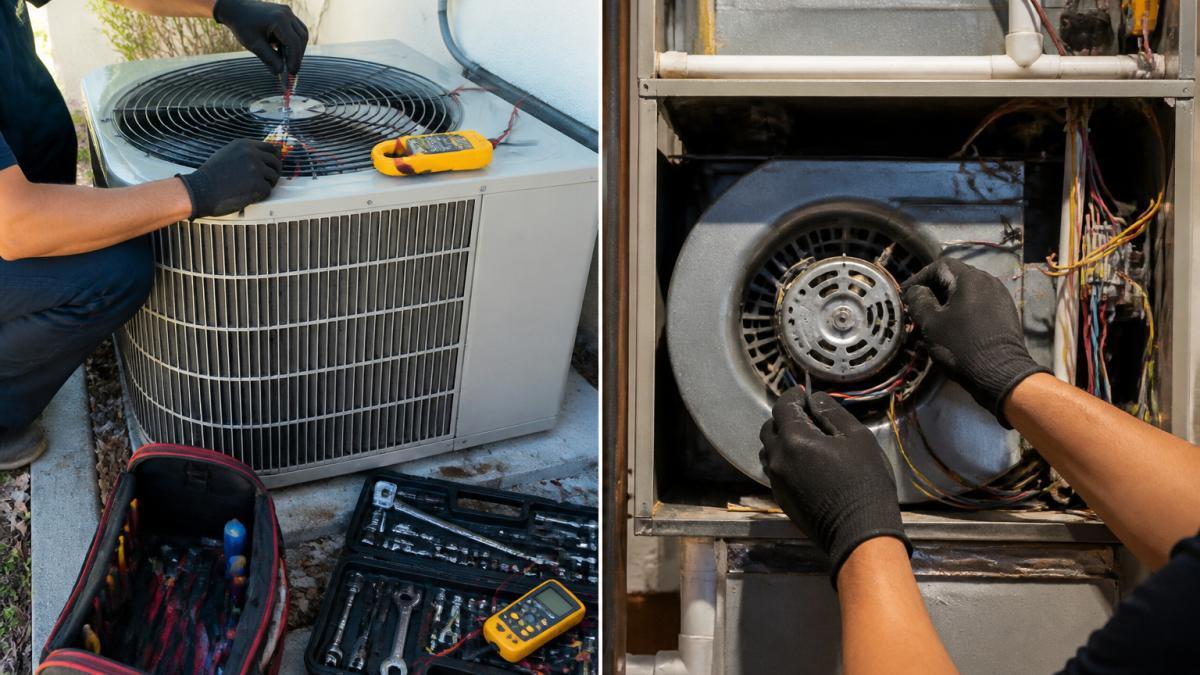
AC Blower Fan Not Working: Indoor Unit Troubleshooting
If air isn't flowing from your vents, your AC fan not turning on could mean the indoor blower motor has stopped.
The indoor blower lives inside your air handler, usually located in an attic, basement, or utility closet.
Check for humming without spinning
Set your thermostat to cooling. Listen at your indoor air handler unit. Do you hear a humming sound but no air movement?
This is a classic sign of a weak or failed capacitor.
Safe troubleshooting step (if you're comfortable):
Turn off power to the air handler at the breaker. Wait 5 minutes. Turn the breaker back on.
If the humming returns but the fan still won't spin, the capacitor has failed and needs replacement. This is a professional repair.
Check for silence (no hum, no spin)
If you hear nothing at all from the air handler, no hum, no fan noise, the motor isn't getting power.
Still nothing? The problem is likely a failed contactor (an electrical switch inside the air handler) or a broken motor.
Blower not running on fan-only mode
Try setting your thermostat to FAN ONLY (not cooling mode). Does the blower spin?
If yes, the motor is fine. Your problem is the cooling call, the thermostat isn't signaling the system to cool.
If no, the blower motor itself is likely broken, or power isn't reaching it.
AC Capacitor Symptoms and Testing
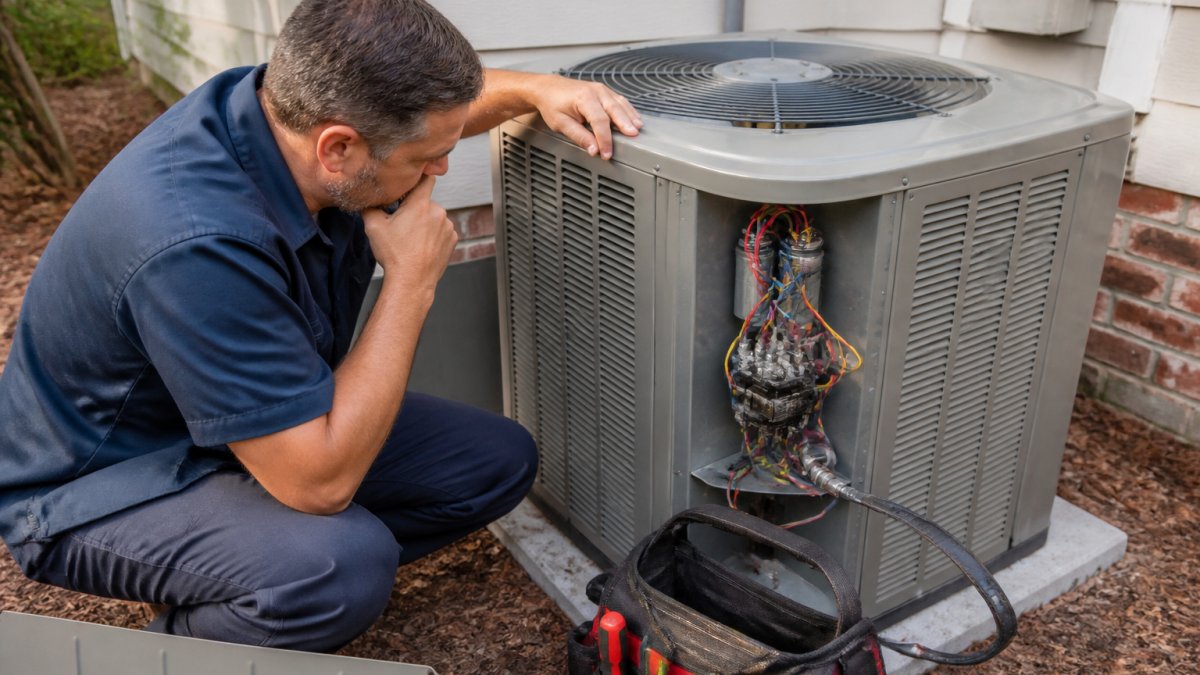
The capacitor is a small cylindrical part that stores electrical energy and releases it in a burst to start the motor. When a capacitor fails, the motor can't start, even though power is present.
Symptoms of a failed capacitor:
- Motor hums but won't spin (humming without rotation)
- Fan blade is stuck and won't turn even when nudged gently
- System was working, then suddenly stopped
- Burning smell near the outdoor unit or air handler
- Visible swelling or bulging on the capacitor itself
Visual inspection
Look at the capacitor near the motor. It's a cylindrical part, usually about 2-3 inches tall, with two or three wire terminals on top. Does it look swollen or domed on top? Is there any discoloration or burn marks?
A visibly damaged capacitor has failed. It needs replacement.
The hum test
If the motor hums when you call for cooling but the fan doesn't spin, the capacitor is almost certainly the problem. The hum means power is reaching the motor, but the capacitor isn't giving it the starting boost it needs.
Do not test the capacitor yourself with a multimeter. Capacitors store electrical charge and can deliver a dangerous shock even when power is off. A professional technician has the tools and training to safely test and replace capacitors.
Capacitor replacement is one of the most common and affordable AC repairs. If this is your problem, the fix is straightforward and relatively inexpensive compared to motor or compressor failure.
AC Fan Motor Troubleshooting and Inspection
If the capacitor is fine and power is reaching the motor, the motor itself may be damaged.
- Complete silence (no hum, no spin)
- Grinding or squealing noise when the fan tries to run
- Fan blade spins slowly or weakly, then stops
- Burning smell coming from the motor
- Motor is hot to the touch (after the system has been running)
Bearing failure
AC motors have bearings that allow the shaft to spin freely. Over time, bearings wear out. A failing bearing sounds like grinding or squealing.
If you hear grinding or squealing, stop running the system. Continued operation will destroy the motor. A technician needs to inspect it.
Burnt-out motor
If the motor won't spin at all and you smell burning, the motor's internal windings have failed.
A burnt-out motor cannot be repaired. It must be replaced.
The nudge test (outdoor fan only)
If the outdoor condenser fan hums but won't spin, try this: turn off power at the disconnect switch. Wait 5 minutes. Turn power back on. Listen for the hum.
When you hear the hum start, gently try to nudge the fan blade by hand (from the outside of the unit, do not reach into the fan). Does it start spinning on its own?
If yes, the motor is weak but functional. It may recover. If no, the motor is seized or the capacitor is too weak. Professional diagnosis is needed.
Never force the blade. You can damage the motor further.
When to Stop Troubleshooting and Call a Professional
You've reached the limit of safe homeowner troubleshooting when:
- You need to test electrical voltage or continuity (requires a multimeter and training)
- You need to discharge a capacitor (requires a specific tool to avoid shock)
- You need to remove or replace the motor itself
- You smell burning or see visible damage to wiring or components
- The system has no power and the breaker keeps tripping
- You're uncomfortable working near electrical components
At Air CareSaver, we recommend calling a licensed technician at this point. Electrical work on AC systems carries real safety risks, electrocution, burns, and equipment damage. A professional diagnosis costs less than guessing and replacing parts that aren't broken.
Many homeowners worry about getting overcharged or sold unnecessary repairs. A reputable technician will explain what's broken, why it broke, and what fixing it costs. If you're not confident in a diagnosis, get a second opinion. Most shops offer free estimates.
Preventing AC Fan Failures: Maintenance Tips
The best fix is prevention. Regular maintenance catches small problems before they become expensive ones.
Change your air filter every 1-3 months
A clogged filter forces your blower to work harder and run hotter (HVAC Proper Installation of Filters). This stresses the motor and capacitor.
Keep the outdoor unit clear
Leaves, dirt, and debris block airflow through the condenser coil. The system overheats. The fan motor runs harder and fails sooner.
Have your system serviced annually
A professional technician inspects the capacitor, motor, wiring, and connections. They clean the coils, check refrigerant levels, and spot problems early. Annual maintenance prevents failures that can be costly.
Watch for warning signs
Listen to your system. Strange noises (grinding, squealing, rattling) signal trouble. Reduced airflow or weak cooling means something is wrong. The sooner you address these signs, the cheaper the fix.
Don't ignore a tripped breaker
If your AC breaker trips repeatedly, something is drawing too much power. A short circuit, a failing motor, or a compressor problem could be the cause.
AC fan failures are frustrating, but most are fixable without replacing the entire unit. Start with the power supply. Check the breaker and disconnect switch. Inspect visible wiring.
If you're in the San Gabriel Valley and need a professional diagnosis, Air CareSaver offers same-day response and free estimates.
Frequently Asked Questions
Why is my AC running but the fan won't turn on?
If your AC unit is running but the fan won't turn on, the compressor may be operating while the fan motor is stuck. This often points to a failed capacitor, stuck fan blade, or electrical disconnect at the fan motor itself. Check whether the outdoor condenser fan or indoor blower is the problem by listening for humming sounds. A humming noise without spinning usually signals a capacitor failure or motor seizure. Do not force the fan blade, call a technician if it won't spin freely by hand.
Can a bad capacitor stop an AC fan from turning on?
Yes. A failed or weak capacitor is one of the most common reasons an AC fan won't turn on. The capacitor stores electrical energy and provides the initial boost to start the fan motor. When it fails, the motor may hum but not spin, or fail to start entirely. AC capacitor symptoms include the fan not responding, a burning smell near the outdoor unit, or a clicking sound from the condenser. A multimeter test can confirm a failed capacitor, but replacement requires a licensed technician.
What should I check if my AC fan won't start?
Start with the simplest checks: verify the thermostat is set to cooling mode and the temperature setting is below the current room temperature. Next, check the circuit breaker for the HVAC system and reset it if tripped. Inspect the disconnect switch near the outdoor unit to confirm it's in the on position. Look for loose wiring connections at the condenser and air handler. If power is present but the fan still won't spin, the issue likely involves the capacitor, fan motor, or contactor, all requiring professional diagnosis.
How do I know if my AC fan motor is bad?
Signs of a failed AC fan motor include the fan refusing to spin even when power is present, a humming or buzzing sound without movement, a burning smell from the outdoor unit, or the fan only spinning when manually nudged. A multimeter can test for voltage at the motor terminals. If voltage is present but the motor won't run, the motor windings are likely burnt out. Do not attempt to force the fan blade or restart a motor that smells burnt, this creates a fire hazard and requires immediate professional replacement.