 listicle
Signs Your HVAC System Needs Repair: 2026 Guide
Table of Contents
- Introduction
- 1. Warm Air Blowing from Vents
- 2. Weak or Inconsistent Airflow
- 3. Unusual Noises: Rattling, Grinding, or Hissing
- 4. Foul or Musty Odors
- 5. High Energy Bills and Why Is My AC Running Constantly?
- 6. Frequent Cycling or Short Cycling
- 7. Humidity Issues and Water Leaks Around the Unit
- DIY vs. Professional Repair: Where to Draw the Line
- Repair vs. Replace: A Simple Decision Framework
- Frequently Asked Questions
Last Updated: September 12, 2026
Introduction
Most homeowners don't realize their HVAC system was broadcasting warning signs for weeks before it finally quit. According to the U.S. Department of Energy's guide to home heating and cooling, heating and cooling account for roughly half of a typical home's energy use, which means a failing system hits your wallet long before it hits your comfort. This guide from Air CareSaver walks through the seven signs your HVAC system needs repair, ranked by how urgently each one demands a call.
Signs your HVAC system needs repair include warm air from the vents, weak airflow, grinding or hissing noises, musty odors, spiking utility bills, short cycling, and water pooling around the unit. Catching these early is the difference between a modest fix and a full system replacement.
At Air CareSaver, our licensed technicians (#1054832) have spent 21+ years diagnosing exactly these symptoms across the San Gabriel Valley, and the pattern is consistent: the homeowners who call at the first rattle avoid the emergency replacement bills. Below, we'll show you how to tell a minor issue from a failing system, when to attempt a DIY check, and when to stop troubleshooting and call a professional.
1. Warm Air Blowing from Vents
Warm air from the vents during cooling season is the clearest signal something has failed in the cooling loop. The most common culprits are a refrigerant leak, a clogged air filter, or a failing compressor.
Here's the practical order to check things yourself:
- Replace the air filter if it looks gray or matted. A clogged filter restricts airflow and can cause the evaporator coil to freeze.
- Check the thermostat. Confirm it's set to "cool" and the temperature is below room temperature.
- Look at the outdoor condenser unit. If ice is visible on the refrigerant lines, turn the system off and call a technician. Running a frozen system can destroy the compressor.
If the filter is clean and the thermostat is correct but the air is still warm, you're likely dealing with a refrigerant leak or a failing compressor. Both require a licensed technician with diagnostic gauges. This is a repair, not a DIY job.
2. Weak or Inconsistent Airflow
Weak airflow is an airflow restriction problem, and it usually traces back to one of three places: a dirty filter, blocked vents, or a failing blower motor. Some rooms staying cool while others stay warm points toward duct issues rather than the unit itself.
Walk through this checklist before calling anyone:
- Replace the air filter (the single most common cause)
- Confirm every supply and return vent is open and unobstructed by furniture or rugs
- Check that no furniture is blocking the return air grille
- Listen at each vent: if some rooms get strong airflow and others barely any, the problem is in the air ducts
Uneven heating and cooling across rooms typically means a duct problem: a disconnected run, a crushed flex duct in the attic, or a damper stuck closed. A technician can diagnose duct issues with a pressure test rather than guesswork. If airflow is weak everywhere, suspect the blower motor, which is an electrical component that wears out over time.
3. Unusual Noises: Rattling, Grinding, or Hissing
Every unusual noise has a specific meaning, and the type of sound tells you how urgent the repair is.
- Rattling usually means a loose panel, a failing blower wheel, or debris in the outdoor unit. It's the least urgent, but it worsens with time.
- Grinding points to a failing blower motor bearing or a compressor on its way out. This is urgent.
- Hissing often indicates a refrigerant leak or a pressure issue in the system. This is urgent and requires immediate attention.
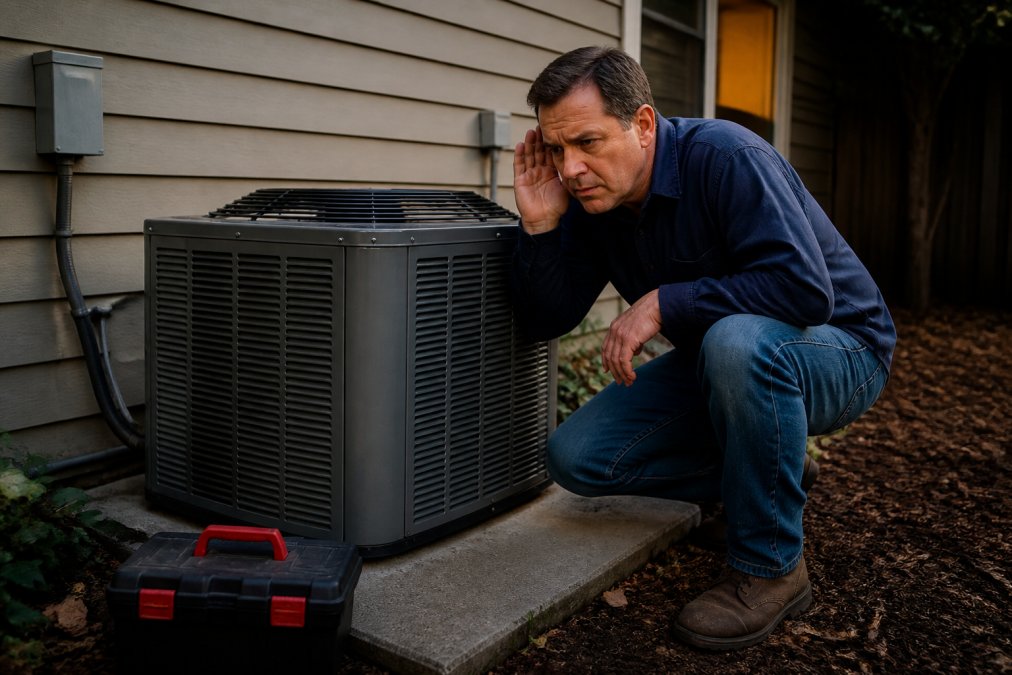
A hissing sound combined with warm air is the classic signature of a refrigerant leak. Refrigerant isn't consumed during normal operation, so a low charge always means a leak somewhere in the system. Continuing to run the unit in this state risks compressor failure.
4. Foul or Musty Odors
A musty smell coming from your vents almost always means mold growth somewhere in the system, typically on the evaporator coil or in the ductwork. The evaporator coil stays wet during cooling season, and in a humid climate that moisture becomes a breeding ground.
The sequence matters here:
- Musty, earthy smell: likely mold or mildew on the evaporator coil or in the air ducts. This needs professional cleaning, not a DIY spray.
- Burning smell: shut the system off immediately. This can indicate an electrical components failure or an overheating motor. Call a technician before restarting.
- Rotten egg smell: this is a gas concern, not an HVAC repair. Leave the building and call your gas utility first.
Mold growth in an HVAC system isn't just unpleasant, it circulates spores through every room. If you or anyone in the home has worsening allergies or headaches that improve when you're away from home, the ductwork is worth inspecting.
5. High Energy Bills and Why Is My AC Running Constantly?
A sudden jump in your utility bills with no change in usage is one of the most reliable early indicators of performance degradation. When an HVAC system loses efficiency, it runs longer to reach the same temperature, and you pay for every extra minute.
So why is my AC running constantly? The most common causes are:
- A refrigerant leak reducing cooling capacity
- A dirty condenser unit or evaporator coil forcing the system to work harder
- Thermostat calibration drift causing the system to overshoot
- A failing compressor that can no longer keep up with demand
Before calling for service, try this: compare your current bill to the same month last year, then check whether your thermostat is holding the set temperature or drifting. If the system runs nonstop and still can't hit the setpoint, that's a capacity problem, not a thermostat problem.
An ENERGY STAR guide to heating and cooling notes that proper maintenance keeps equipment running at its rated efficiency, which is why a system that's never been serviced tends to drift upward on bills year over year.
6. Frequent Cycling or Short Cycling
Short cycling is when your system turns on and off in rapid bursts instead of running in normal cycles. It's one of the most damaging patterns for an HVAC system because every startup draws a surge of current and stresses the compressor.
The usual causes are an oversized system, a refrigerant charge that's too high or too low, a failing thermostat, or a clogged filter causing the system to overheat and trip its safety switch. Short cycling also shortens system lifespan because the compressor never gets to run in its efficient steady state.
If your system cycles more than roughly three to four times per hour on a mild day, that's worth a diagnostic visit. A technician can check the refrigerant charge and thermostat calibration in a single appointment, and both are inexpensive fixes compared to the compressor failure that short cycling eventually causes.
7. Humidity Issues and Water Leaks Around the Unit
An HVAC system does two jobs: it cools the air and it removes humidity. When humidity control fails, you'll notice clammy air, fogged windows, and a house that never quite feels comfortable no matter what the thermostat says.
Water leaks around the unit are the more urgent version of this problem. A clogged condensate drain line is the most common cause, and it's a straightforward fix. But standing water near the indoor unit can also mean a cracked drain pan or a frozen coil that's thawing. Left alone, that moisture damages drywall, floors, and nearby electrical components.
Here's how to tell which problem you have:
| Symptom | Likely Cause | Urgency |
|---|---|---|
| Clammy air, high indoor humidity | Oversized system or failing humidity control | Schedule soon |
| Water dripping from indoor unit | Clogged condensate drain line | Fix within days |
| Standing water, musty smell | Cracked drain pan or frozen coil | Call immediately |
| Water near outdoor unit | Refrigerant line condensation or drainage issue | Schedule soon |
If you're weighing whether a repair is worth it on an older system, a repair vs. replace calculator can help frame the decision, but the honest answer usually comes down to age, repair frequency, and how the system has performed over the last two seasons.
DIY vs. Professional Repair: Where to Draw the Line
Some HVAC symptoms are safe to check yourself, and some aren't. Knowing the difference saves money on unnecessary service calls and prevents injuries or further damage.
Safe to check yourself:
- Replacing the air filter
- Confirming vents are open and unobstructed
- Checking the thermostat settings and batteries
- Clearing visible debris from around the outdoor condenser unit
- Inspecting for visible water leaks or ice buildup
Call a licensed technician:
- Any refrigerant issue (hissing, ice on lines, warm air after filter replacement)
- Electrical components, including the blower motor and capacitors
- Compressor problems or grinding noises
- Mold growth in the ductwork or evaporator coil
- Gas smells or burning odors
Refrigerant handling is regulated at the federal level, and technicians must be certified to purchase and handle it, as outlined by the EPA Section 608 refrigerant handling requirements. That's not a rule you can work around with a hardware store kit.
Repair vs. Replace: A Simple Decision Framework
The repair-or-replace decision comes down to three variables: age, repair frequency, and efficiency trend. Use this framework:
- Under 10 years old, first major repair: repair it. The system has useful life left.
- 10 to 15 years old, second repair in two years: start pricing replacement. You're on the downward slope.
- Over 15 years old, any major repair: replacement usually wins on total cost over the next five years.
- Any age, compressor failure: replacement is often the better financial call, since compressor replacement approaches the cost of a new system.
For an aging system, a preventative maintenance checklist is the cheapest way to extend its life. Have a technician inspect the following each season:
- Air filter replacement (monthly during peak use)
- Condenser and evaporator coil cleaning
- Refrigerant charge check
- Thermostat calibration
- Condensate drain line flush
- Electrical component inspection
- Blower motor lubrication and inspection
Maintenance doesn't just prevent breakdowns. It keeps energy efficiency near the system's rated level, which shows up on every utility bill.
An HVAC failure rarely happens without warning. The signs are there in the noise, the airflow, the smell, and the bill, and the homeowners who act on them early avoid the emergency replacement. If you're seeing any of the symptoms above, Air CareSaver offers same-day response and free estimates, backed by 21+ years of licensed experience (#1054832), a 4.9 Google rating, and 270+ reviews from neighbors across the San Gabriel Valley. Our technicians diagnose the actual problem before recommending any repair, so you're not paying for parts you don't need. Get started with Air CareSaver and restore year-round comfort before a small repair becomes a full system replacement.
Frequently Asked Questions
What is the $5,000 rule for HVAC repair vs. replacement?
The $5,000 rule is a guideline: if the cost of a repair multiplied by the age of your system exceeds $5,000, replacement may be more cost-effective. For example, a 10-year-old system needing a $600 repair gives $6,000, suggesting replacement. However, this is just one factor. Consider energy efficiency, repair frequency, and system lifespan. A professional HVAC technician can help you apply this rule accurately.
What is the average lifespan of an HVAC system?
Most HVAC systems last 15 to 20 years with proper maintenance. Regular air filter replacement, annual tune-ups, and timely repairs can extend lifespan. Systems in harsh climates or with neglected maintenance may fail sooner. If your system is over 15 years old and needs frequent repairs, it may be time to consider replacement for better energy efficiency and reliability.
Is it worth fixing a 20-year-old AC unit?
It depends on the repair cost and overall condition. If the repair is minor and the system has been well-maintained, it might be worth fixing. However, a 20-year-old unit is near the end of its lifespan and may have declining energy efficiency. A repair vs. replace calculator can help you weigh the costs. Consult a licensed HVAC technician for a thorough evaluation.
What are the most common parts to fail on an HVAC system?
Common failure points include capacitors, compressors, blower motors, and thermostats. Capacitors often fail due to heat and age, causing the system to not start. Compressor failure is more serious and costly. Blower motors can wear out, leading to weak airflow. Regular maintenance can catch these issues early and prevent major breakdowns. If you notice signs like unusual noises or inconsistent cooling, call a professional.