 how-to
Impact of Poor HVAC Maintenance on Business Operations
Table of Contents
- The Real Cost of Neglecting Commercial HVAC Maintenance
- Signs Commercial HVAC Needs Maintenance: 8 Warning Signals
- How Poor HVAC Maintenance Hurts Your Bottom Line
- Indoor Air Quality, Employee Productivity, and Customer Experience
- Your Preventive HVAC Maintenance Checklist
- Building a Commercial HVAC Maintenance Schedule by Equipment Type
- Commercial HVAC Maintenance Contract Pricing: What to Expect
- Frequently Asked Questions
Last Updated: October 15, 2026
The Real Cost of Neglecting Commercial HVAC Maintenance
Neglecting commercial HVAC maintenance quietly raises energy use, repair bills, and downtime until a breakdown forces the issue. HVAC maintenance is the scheduled inspection, cleaning, and repair of heating and cooling equipment to keep it running safely and efficiently.
The U.S. Department of Energy reports that heating and cooling account for roughly half of a typical building's energy use, and that dirty filters and neglected coils push that number higher (U.S. Department of Energy guide to heating and cooling).
Below, we break down the real numbers, the warning signs, and the schedule that keeps a system running.
How Deferred Maintenance Compounds Over Time
Small problems do not stay small. A clogged filter makes the blower work harder, pulling more amps and running hotter while the compressor strains to keep up. Each part wears faster, and efficiency drops a little more.
By the time something breaks, you are paying for the repair plus all the wasted energy from the months before it. Environmental Protection Agency notes that regular maintenance helps equipment run more efficiently and can extend its service life (EPA guidance on maintaining HVAC equipment).
Signs Commercial HVAC Needs Maintenance: 8 Warning Signals
The clearest signs commercial HVAC needs maintenance are rising energy bills, weak airflow, strange noises, and frequent cycling. Catching these early turns a major repair into a routine service call:
- Utility bills climbing with no change in usage
- Weak or uneven airflow from vents
- Strange noises: grinding, rattling, or squealing
- The system short-cycles, turning on and off constantly
- Warm air from vents when cooling is on
- Musty or stale smells near vents
- Frequent filter changes or visibly dirty filters
- More occupant complaints about hot and cold spots
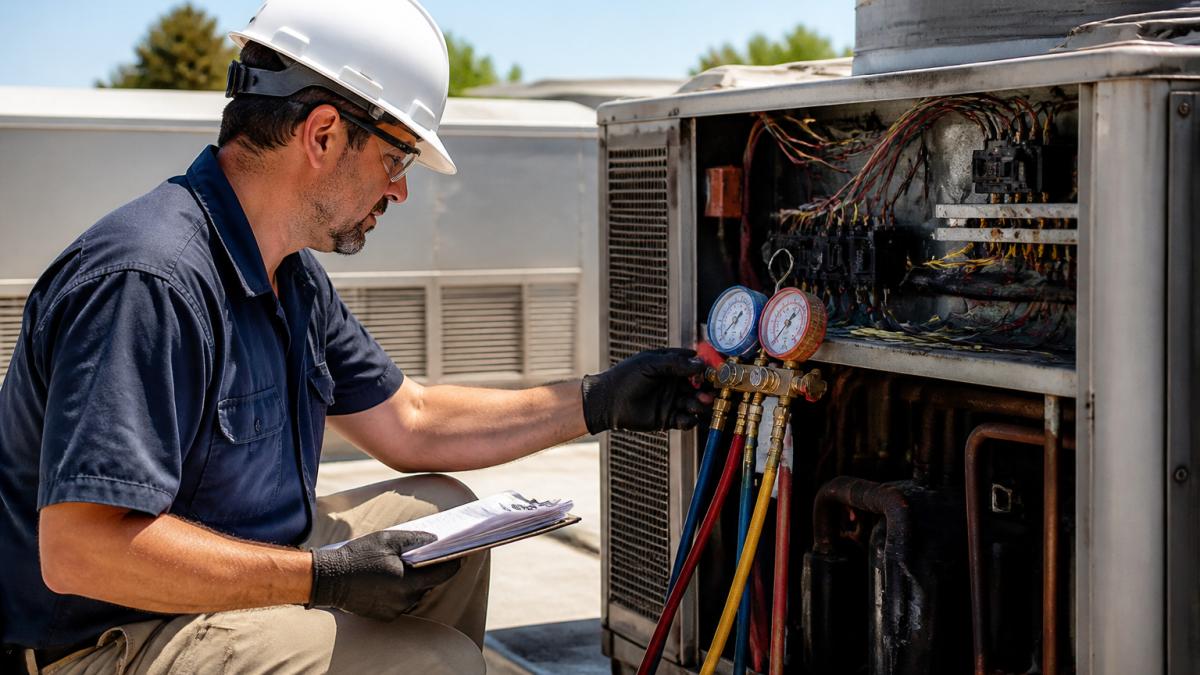
Two or more of these signals together point to a system that needs attention now, not at the next seasonal check.
How Poor HVAC Maintenance Hurts Your Bottom Line
Poor HVAC maintenance hits the bottom line three ways: wasted energy, surprise repairs, and lost operating hours. The three add up faster than most owners expect.
Energy Waste and Rising Utility Bills
A dirty system has to run longer to hit the same temperature. Longer run times mean higher energy consumption, and higher consumption shows up on every utility bill. The Department of Energy points out that a well-maintained system uses noticeably less energy than a neglected one (Energy Saver program on efficient heating and cooling). Energy waste is the quietest cost, because it never sends a bill you can point to.
Unexpected Repairs and Equipment Failure
Neglected parts fail without warning, and the repair is bigger, the parts cost more, and the system may be down for days. A maintenance plan catches worn belts, loose connections, and low refrigerant before they turn into a full equipment failure.
Operational Downtime and Lost Revenue
Downtime is the cost owners feel fastest. A retail floor that hits 85 degrees empties out, and an office that loses cooling sends staff home. Every hour the system is down is an hour of lost sales or lost work.
Indoor Air Quality, Employee Productivity, and Customer Experience
Indoor air quality ties directly to how well people work and how long customers stay. Poor air circulation lets dust, allergens, and contaminants build up inside, and dirty filters and coils make it worse.
The EPA lists indoor air pollutants among the top environmental risks to public health (EPA indoor air quality resources). For a business, that shows up as more occupant complaints, lower employee productivity, and higher absenteeism.
Your Preventive HVAC Maintenance Checklist
A preventive HVAC maintenance checklist keeps service consistent so nothing gets skipped. Use this list at every scheduled visit:
- Replace or clean air filters
- Inspect and clean evaporator and condenser coils
- Check refrigerant charge and look for leaks
- Lubricate motors and moving parts
Documenting each visit builds a service history, which helps with warranty coverage and shows how the system is aging.
Building a Commercial HVAC Maintenance Schedule by Equipment Type
A commercial HVAC maintenance schedule should match service frequency to each piece of equipment, then sequence the work so nothing collides with peak operating hours. The workflow below adds who does what, when, and how to adjust when the load changes.
The Frequency Framework
| Equipment | Service Frequency | Key Tasks | Who Typically Performs It |
|---|---|---|---|
| Air filters | Monthly to quarterly | Replace or clean; note pressure drop | In-house staff or service provider |
| Rooftop units | Twice a year (spring and fall) | Coils, belts, refrigerant charge, economizer | Licensed technician |
| Split systems | Twice a year | Filters, coils, condensate drains | Licensed technician |
| Boilers | Annually, before heating season | Combustion analysis, safety controls, relief valve | Licensed technician |
| Cooling towers | Quarterly | Water treatment, basin cleaning, drift eliminator check | Licensed technician or water-treatment vendor |
| Thermostats and controls | Annually | Calibration, sensor verification, schedule review | Technician or controls vendor |
| Condensate drains | Quarterly during cooling season | Flush, treat, verify trap | In-house staff or technician |
The Annual Workflow, Month by Month
A practical pattern many facility teams follow:
- Late winter (February-March): Schedule spring rooftop and split-system service before cooling demand arrives. Order filters for the year so you are not paying rush shipping in July.
- Early spring (April-May): Complete coil cleaning and refrigerant checks. Verify economizer dampers open and close fully, a stuck economizer is one of the most common hidden energy drains.
- Summer (June-August): Log filter pressure drops, condenser entering-air temperatures, and occupant complaints. Address small issues between scheduled visits rather than waiting.
- Early fall (September-October): Schedule heating-side service: boilers, heat exchangers, ignition systems, and safety controls. Inspect belts and bearings before the heating load stresses them.
How to Adjust the Schedule for Your Building
Adjust frequency upward when any of these apply:
- The space runs 12+ hours a day or seven days a week.
- The building has high occupant density, cooking, or manufacturing processes that load the air.
- The equipment is more than 10 years old or has a history of repairs.
- The building sits in a climate with heavy pollen, dust, or coastal salt air.
Adjust frequency downward only when the equipment is new, lightly loaded, and documented as clean at every inspection. Even then, do not skip the annual professional visit, it catches the problems filters cannot.
Documentation That Makes the Schedule Work
Every visit should produce a written record: date, technician, tasks performed, readings taken, parts replaced, and any item flagged for follow-up. Keep the records with the equipment, not in a folder nobody opens. When a warranty claim or an insurance question arises, that log is the evidence that the system was maintained. It also lets a new technician understand the system's history on the first visit instead of the third.
In-House vs. Contracted Tasks
Some tasks are safe for trained in-house staff: filter changes, visual inspections, drain flushing, and record-keeping. Others require a licensed technician: refrigerant handling, combustion analysis, electrical diagnostics, and anything involving gas or high-voltage components. Splitting the work this way lowers contract cost without sacrificing the tasks that protect the equipment and occupants.
Commercial HVAC Maintenance Contract Pricing: What to Expect
Commercial HVAC maintenance contract pricing depends on the number of units, their size, their age, and how often they need service. A single rooftop unit on a light schedule costs far less to maintain than a building full of equipment running every day. There is no single number that fits all, but understanding the cost drivers lets you compare proposals fairly.
What Drives the Price
Five variables explain most of the difference between two quotes:
- Unit count and tonnage. More units and larger tonnage mean more labor hours per visit. A building with ten rooftop units will always cost more to maintain than one with two.
- Service frequency. Monthly visits cost more than quarterly visits, but the trade-off is earlier detection of wear. For equipment running near capacity, the higher frequency usually pays for itself in avoided repairs.
- Equipment age and condition. Older systems need more attention per visit. A provider who quotes the same price for a 20-year-old unit and a new one is either underpricing the old unit or overpricing the new one.
- Included parts. Filter replacement is the biggest variable. A contract that includes filters costs more up front but removes the surprise of a filter invoice mid-season.
What a Contract Should Include
Before comparing prices, compare scopes. A contract should state, in writing:
- A clear service frequency for each unit, by equipment type
- Whether filter replacement is included, and what filter grades are covered
- Documented inspections with readings after every visit
- Priority scheduling for repairs, with a stated response window
A low headline price with a narrow scope is not a bargain. It is a repair bill waiting to happen.
How to Compare Two Proposals
Normalize the proposals before you decide:
- Divide the annual contract price by the number of units to get a per-unit cost.
- Count the number of scheduled visits per unit per year.
- List which parts and labor are included versus billed separately.
- Note the response-time commitment in writing.
- Ask each provider to walk through what happens on a breakdown, who answers, how fast, and what the after-hours rate is.
The proposal with the lowest per-unit cost and the narrowest scope is usually the most expensive over a year. The proposal with a clear scope, documented visits, and a defined response window is usually the better value even when the headline number is higher.
Questions to Ask Before You Sign
- How many visits per year, and what happens on each one?
- Are filters included, and what grade?
- What is the response time for a no-cool or no-heat call?
- What is the after-hours rate, and is it capped?
- Who performs the work, employees or subcontractors?
A provider who will not put the scope in writing is not one you want maintaining equipment your business depends on. Ask for a free estimate and a written scope before signing anything. If the answers are vague, keep looking.
Frequently Asked Questions
How can poor HVAC maintenance affect business operations?
Neglected HVAC maintenance drives up energy consumption, increases repair costs compared to maintained systems, and causes unexpected breakdowns that halt business operations. Poor indoor air quality from dirty filters and coils leads to employee absenteeism and occupant complaints. Over time, deferred maintenance shortens equipment lifespan, forcing premature replacement for business owners.
What are the signs that a commercial HVAC system needs maintenance?
Watch for rising utility bills without usage changes, uneven temperatures across zones, unusual noises or odors, frequent cycling, weak airflow, excessive dust, and repeated service calls for the same issue. Water leaks or ice buildup on coils also signal problems. If occupants complain about stuffiness or allergies, your filters or ventilation likely need attention. Catching these signs early prevents costly breakdowns and keeps your system running efficiently.
How often should a commercial HVAC system be maintained?
Most commercial HVAC systems need professional maintenance twice per year, once before cooling season and once before heating season. High-use facilities like restaurants or data centers may need quarterly service. A commercial HVAC maintenance schedule should include monthly filter checks, quarterly coil cleaning, and annual inspections of belts, motors, and refrigerant levels. Following a preventive HVAC maintenance checklist reduces emergency calls and extends equipment life.
Can neglected HVAC maintenance increase energy bills?
Yes. Dirty filters, clogged coils, and refrigerant leaks force your system to work harder to reach set temperatures. This increases energy consumption, which shows up directly on utility bills. Over a year, that wasted energy adds up to significant operating expenses. Regular maintenance restores system performance and keeps energy costs predictable for your business.