 listicle
Same Day Emergency HVAC Repair Services: 2026 Guide
Table of Contents
- What Counts as an HVAC Emergency (and What Can Wait)
- Signs of HVAC System Failure You Should Never Ignore
- How to Troubleshoot Your HVAC System Before Calling a Pro
- What Same Day Emergency HVAC Repair Services Should Offer
- Understanding 24/7 Emergency HVAC Repair Cost
- How to Vet a Provider Before You Say Yes
- Frequently Asked Questions
Last Updated: September 14, 2026
What Counts as an HVAC Emergency (and What Can Wait)
A same day emergency HVAC repair service is a licensed contractor that dispatches a technician to your home or business within hours of your call, typically for no-heat, no-cool, or safety-related failures. At Air CareSaver, we've handled these calls across the San Gabriel Valley for more than 21 years, and the first question we ask is always the same: is this actually an emergency, or can it wait until morning?
Here's the honest answer most companies won't give you. A system blowing warm air on a 95-degree afternoon with an infant or elderly resident in the house is an emergency. A single room that runs two degrees warmer than the rest of the house is not.
True emergencies include:
- No cooling during extreme heat, especially with vulnerable occupants
- No heat when overnight temperatures drop near freezing
- A burning smell, repeated breaker trips, or a system that won't shut off
- Water pooling around the indoor unit or a refrigerant line coated in ice
- Carbon monoxide detector alarms tied to a gas furnace
What can usually wait for a scheduled visit:
- Uneven temperatures between rooms
- Minor rattling or humming that doesn't affect output
- A thermostat that needs recalibration
- Routine filter changes and seasonal tune-ups
The distinction matters because emergency dispatch carries a premium, and you shouldn't pay it for a problem that isn't urgent. The U.S. Department of Energy guidance on home heating and cooling makes the same point: catching small issues early is almost always cheaper than waiting for a full breakdown.
Signs of HVAC System Failure You Should Never Ignore
The clearest signs of HVAC system failure are rising energy bills without a change in usage, weak airflow from vents, strange noises, and frequent cycling. Any one of these signals that something is straining, and two or more together usually mean a component is close to failing.
Watch for these specific warning signs:
- Short cycling: The system turns on and off every few minutes instead of running in normal cycles. This wears out the compressor, the most expensive part to replace.
- Weak or uneven airflow: Some rooms never reach temperature. This often points to duct leaks or a failing blower motor.
- Rattling, screeching, or grinding: A loose part, a worn bearing, or debris in the outdoor unit. Grinding usually means the motor is on its way out.
- Moisture or ice: Ice on the refrigerant lines or water around the indoor unit signals a refrigerant leak or a clogged drain line.
- Yellow burner flame: A gas furnace should burn blue (energy.gov). A yellow flame can indicate incomplete combustion.
What most guides miss is that homeowners often wait for a total breakdown when these early signals are cheap to fix. A failing capacitor costs far less to replace than the compressor it takes down with it.
How to Troubleshoot Your HVAC System Before Calling a Pro
Before you call for emergency HVAC repair, run through the basics. A surprising share of "emergency" calls turn out to be a tripped breaker, a dead thermostat battery, or a filter so clogged the system can't move air. This 15-minute checklist resolves many of them.
The 15-Minute Checklist: Thermostat, Breaker, Filter
Work through these steps in order. Stop as soon as the system responds.
- Thermostat: Confirm it's set to COOL or HEAT (not FAN), the temperature is at least 3 degrees below or above room temperature, and the display is on. Replace the batteries if it's blank or dim.
- Breaker: Find your electrical panel and check the breaker labeled for the HVAC system. If it's tripped, reset it once. If it trips again immediately, stop and call a professional.
- Filter: Pull the filter and hold it up to a light. If you can't see through it, replace it. A clogged filter restricts airflow and can freeze the coil.
- Outdoor unit: Clear leaves, dirt, and debris from around the condenser. Make sure the disconnect switch nearby is in the ON position.
- Drain line: Check the condensate drain pan for standing water. A float switch may have shut the system off to prevent overflow.
If the system still won't run after these steps, the problem is internal and you need a licensed technician.
What Same Day Emergency HVAC Repair Services Should Offer
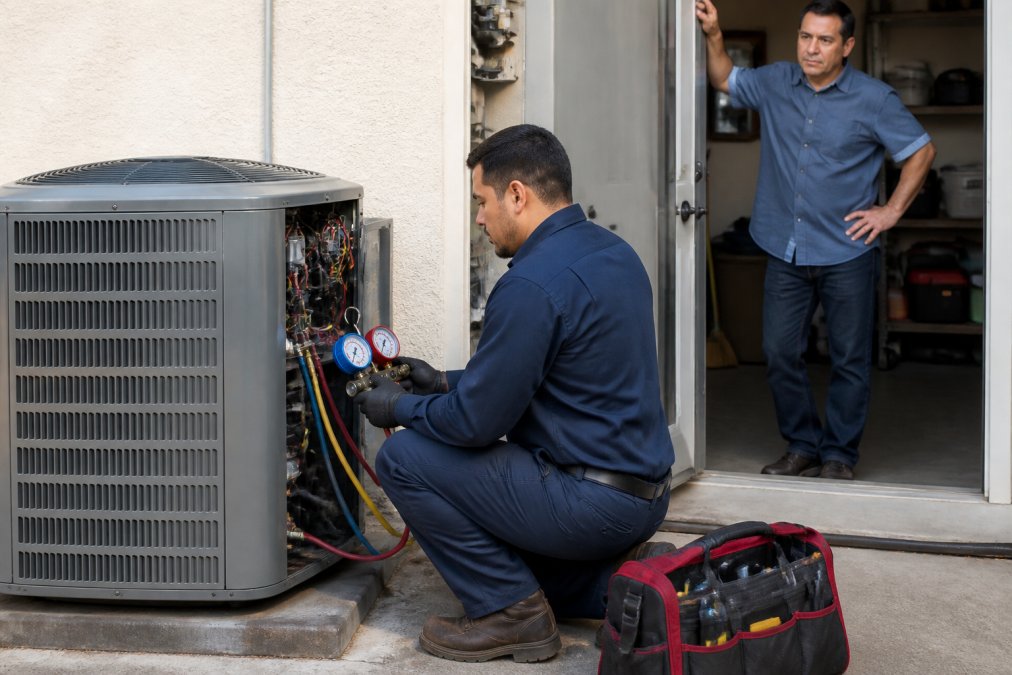
A legitimate same day emergency HVAC repair service should offer 24/7 dispatch, upfront diagnostics, licensed technicians, and a clear explanation of the problem before any work begins. Anything less and you're gambling with your money and your comfort.
Licensing, Free Estimates, and No-Guesswork Diagnostics
The single most important thing to verify is licensing. In California, HVAC contractors must hold a valid license through the Contractors State License Board, and you can look up any license number in seconds. Air CareSaver operates under license #1054832, and we encourage every customer to verify it before we arrive.
Beyond licensing, here's what a trustworthy provider delivers:
- Free estimates so you know the scope before you commit
- Accurate diagnostics that identify the actual failed component, not a guess
- No unnecessary parts pushed onto the invoice
- Same-day response for genuine emergencies, not a three-day wait
- Clear communication about what failed, why, and what it costs to fix
The difference between a good provider and a bad one usually comes down to whether they diagnose or guess. A technician who replaces parts until something works is charging you for their uncertainty.
Understanding 24/7 Emergency HVAC Repair Cost
Emergency HVAC repair cost depends on the time of day, the failed component, and whether the call requires after-hours dispatch. Most providers charge a service call fee plus parts and labor, and many add an overtime premium for nights, weekends, and holidays.
What drives the final number up or down:
| Cost Factor | What Affects It | How to Control It |
|---|---|---|
| Time of call | After-hours and holiday dispatch carries a premium | Call during business hours when the issue can safely wait |
| Failed component | Capacitors and relays cost far less than compressors | Ask for a written diagnosis before approving work |
| Parts availability | Common parts are stocked; rare ones are ordered | Choose a provider with local parts inventory |
| System age | Older systems can be harder to source parts for | Ask whether repair or replacement makes more sense |
| Service area | Distance and travel time factor in | Use a local provider familiar with your area |
Ask every provider two questions before you book: what is your service call fee, and do you charge overtime. A company that answers both clearly is one you can trust with the rest.
How to Vet a Provider Before You Say Yes
Vetting an HVAC provider takes about five minutes and saves you from the worst outcomes: unlicensed work, surprise invoices, and repairs that fail within weeks. Start with the license lookup, then work through the rest.
Run this check before you book anyone:
- Verify the license on your state's contractor board website. Confirm it's active and in good standing.
- Ask for the license number upfront. A provider who hesitates is a red flag.
- Request a written estimate covering the diagnosis, parts, and labor.
- Confirm emergency hours in writing, including whether overtime applies.
- Read recent reviews and look for patterns, not single complaints.
- Ask what happens if the repair doesn't hold. A reputable company stands behind its work.
What separates a provider worth calling from one you'll regret is transparency. A company that explains the diagnosis, shows you the failed part, and gives you options is treating you like an adult. That's the standard you should hold every contractor to, and it's the standard we hold ourselves to at Air CareSaver.
Frequently Asked Questions
What counts as an HVAC emergency?
An HVAC emergency is any failure that threatens health, safety, or property. In practice, that means no cooling when outdoor temperatures climb into the 90s, no heat during a cold snap, a system blowing warm air, burning smells, repeated breaker trips, or water pooling around the unit. If anyone in the home is elderly, very young, or has a health condition, treat any loss of heating or cooling as urgent.
How much do same day emergency HVAC repair services usually cost?
Pricing depends on the diagnosis, parts needed, and time of day, so most providers quote after an on-site inspection rather than over the phone. Some companies charge a flat service call fee, while others waive the diagnostic fee if you approve the repair. Ask about after-hours rates, overtime charges, and whether the quote includes parts and labor before you authorize any work. Request a free estimate in writing.
Can I troubleshoot my HVAC system myself before calling a pro?
Yes, and it often saves you a service call. Check the thermostat batteries and settings, confirm the breaker has not tripped, replace a clogged filter, and clear any visible ice from the outdoor unit. If the system still will not start, or if you smell gas or burning, stop and call a licensed technician. Never open the refrigerant lines or electrical panel yourself.
How do I find a licensed HVAC technician near me?
Ask for the license number and verify it with your state licensing board, then confirm the company carries liability insurance and workers' compensation. Read recent reviews for response times, not just star ratings. Local, family-owned companies with years in the same service area usually have more at stake in doing the job right than a rotating network of subcontractors. Get a written estimate before work starts.
What should I do while waiting for emergency HVAC repair?
Turn the system off at the thermostat to prevent further damage, especially if you hear grinding or see ice. Move pets and children away from the unit, open windows or use fans if it is safe, and if the heat is out in freezing weather, gather in one room and use space heaters with care. Keep the area around the indoor and outdoor units clear so the technician can work without delay.
When your system fails at the worst possible moment, the last thing you need is a runaround. Air CareSaver is a family-owned, licensed team (#1054832) with more than 21 years of experience serving homes and businesses across the San Gabriel Valley, backed by a 4.9 Google rating from 270+ reviews. We offer same-day response, free estimates, and accurate diagnostics that fix the actual problem instead of guessing. Get started with Air CareSaver and restore your comfort today with a free quote.