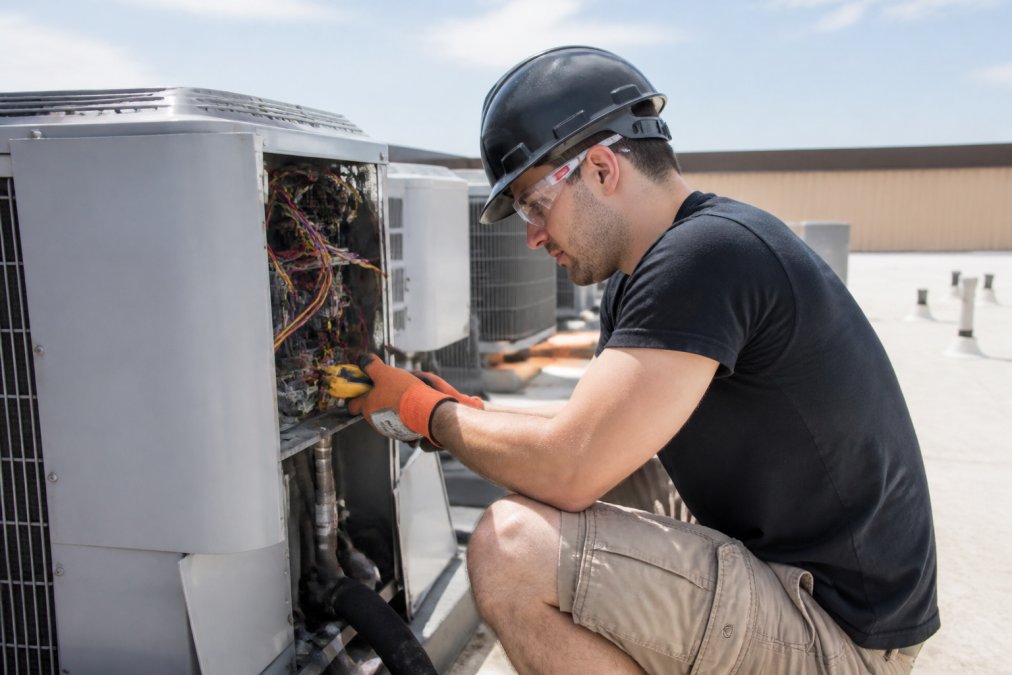
 how-to
How to Maintain HVAC Systems for Small Businesses
Table of Contents
- Why Regular HVAC Maintenance Matters for Small Businesses
- What You'll Need Before You Start
- Your Commercial HVAC Maintenance Checklist
- How Often to Service Commercial HVAC Equipment
- DIY vs. Professional HVAC Maintenance: Where to Draw the Line
- Understanding Commercial HVAC Maintenance Contract Pricing
- How to Maintain HVAC Systems Year-Round Without Breaking Your Budget
- Common Mistakes That Shorten HVAC Equipment Lifespan
- Frequently Asked Questions
Last Updated: September 15, 2026
Why Regular HVAC Maintenance Matters for Small Businesses
A commercial HVAC system does not fail all at once. It loses efficiency, then reliability, then the compressor. Learning how to maintain HVAC systems for small businesses is about controlling that decline before it becomes a closed office in July.
Commercial HVAC maintenance is the scheduled inspection, cleaning, and adjustment of heating and cooling equipment to preserve airflow, energy efficiency, and equipment lifespan. For a small business, the payoff is operational: no surprise downtime, predictable operating costs, and equipment that lasts its full service life instead of half of it.
The stakes are higher than most owners assume. One commercial unit often serves customers, inventory, and staff at once, so when it stops, revenue stops. At Air CareSaver, 21 years of service show the preventable failures almost always trace back to skipped filters, dirty condenser coils, and ignored drain lines.
This guide covers the tasks your own team can handle, when to call a licensed technician, and how to budget for the whole thing without guessing.
What You'll Need Before You Start
Gather your tools and records before touching the equipment; a maintenance visit without a baseline is guesswork.
- The manufacturer's manual for each unit, or the model and serial numbers if the manual is gone
- A maintenance log (paper binder or spreadsheet) with dates, tasks, and readings
- Replacement air filters in the correct size, bought in bulk
- Fin comb, soft brush, coil cleaner rated for your coil type
- Screwdrivers, nut drivers, and a multimeter
- A non-contact thermometer for supply and return air readings
- Safety glasses and gloves
- A licensed HVAC contractor's number, for anything past the filter rack
Your Commercial HVAC Maintenance Checklist
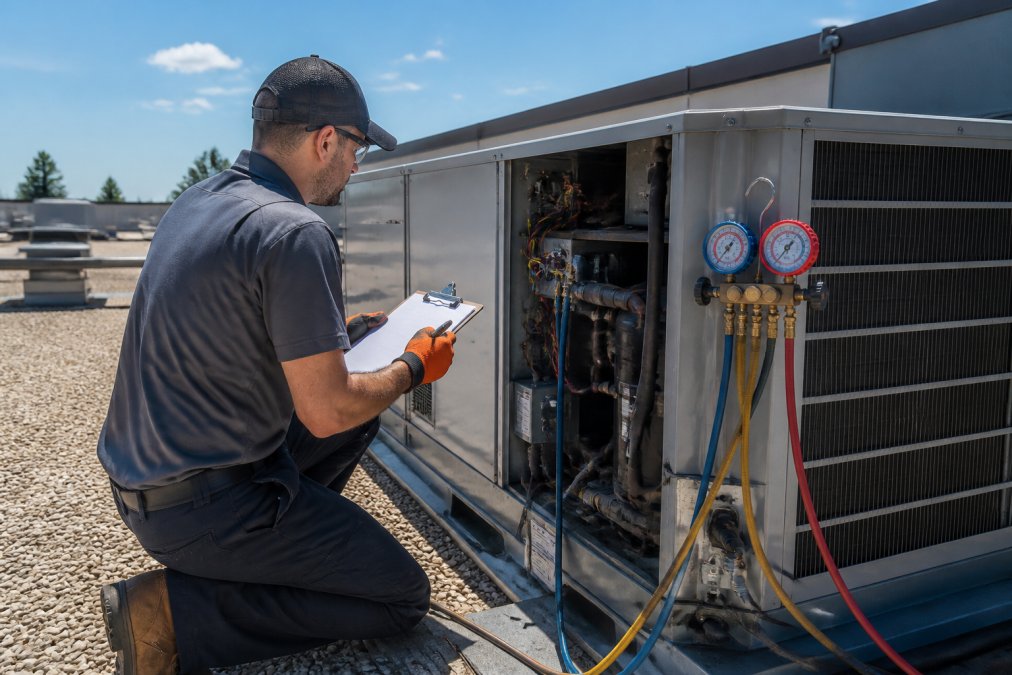
A commercial HVAC maintenance checklist is a written sequence of inspections performed on a set schedule, with results recorded each time. The order below catches the most common failures fastest.
Monthly Tasks Your Team Can Handle
These are safe, low-skill tasks that prevent the majority of avoidable breakdowns.
- Replace or clean air filters. Check monthly and replace when loaded. Restricted airflow is the most common cause of frozen coils and overheating.
- Clear the condensate pan and drain lines. Standing water grows biological growth and trips a float switch, shutting the system down.
- Inspect the outdoor unit. Remove leaves, clippings, and debris, and keep clearance on all sides.
- Check the thermostat. Confirm settings match occupancy, and replace batteries on battery-powered models.
- Log supply and return air temperatures. A widening gap between them signals a developing problem.
Quarterly and Seasonal Tasks
These require more time and, in some cases, a technician.
- Clean condenser coils. Dirty coils raise head pressure and energy use.
- Inspect electrical connections. Look for discoloration, corrosion, and loose terminals; tighten only what you are qualified to tighten.
- Check refrigerant lines for oil or frost. Both point to a leak or charge problem.
- Inspect the blower motor and belt tension. A slipping belt cuts airflow and strains the motor.
- Examine the heat exchanger before heating season. Cracks are a safety issue.
- Test the condensate pump and float switch. Do this before cooling season.
How Often to Service Commercial HVAC Equipment
Commercial HVAC equipment should be serviced quarterly at minimum, with monthly filter checks and semi-annual deep service before each heating and cooling season. High-use facilities like restaurants and server rooms often need monthly professional attention.
The right frequency depends on how hard the equipment works:
| Facility Type | Filter Check | Professional Service | Why |
|---|---|---|---|
| Small office | Monthly | Quarterly | Predictable load, moderate dust |
| Retail store | Monthly | Quarterly | Door traffic pulls in debris |
| Restaurant | Weekly | Monthly | Grease and heavy particulate load |
| Server or IT room | Monthly | Quarterly | Continuous runtime, heat-sensitive |
| Warehouse | Monthly | Quarterly | Dust and wide temperature swings |
Seasonal transition matters as much as frequency. Spring focuses on condenser coils, refrigerant levels, and drain lines; fall shifts to the heat exchanger, ignition system, and blower assembly. Skipping the fall visit means discovering a heating failure on the first cold morning.
DIY vs. Professional HVAC Maintenance: Where to Draw the Line
The dividing line is simple: if a task requires opening a refrigerant circuit, handling electrical components, or interpreting pressures and temperatures, it belongs to a licensed technician. Everything upstream is fair game for your team.
Your team can handle:
- Filter replacement and inventory
- Condensate pan and drain line clearing
- Outdoor unit debris removal
- Thermostat scheduling and battery changes
- Visual inspection and log entries
A licensed technician should handle:
- Refrigerant level checks and charging
- Electrical connection tightening and component testing
- Compressor, contactor, and capacitor diagnostics
- Heat exchanger inspection for cracks
- Thermostat calibration and control board diagnosis
Understanding Commercial HVAC Maintenance Contract Pricing
Commercial HVAC maintenance contract pricing depends on equipment count and type, square footage, service frequency, and coverage. Most small businesses choose between three contract structures, and the structure matters more than the headline number.
The three contract types you will be quoted:
- Inspection-only (basic). Two visits per year, visual inspection and a written report. Filters, refrigerant, and parts billed separately. Lowest cost, lowest coverage.
- Preventative maintenance (mid-tier). Quarterly visits, filters included, coil cleaning, belt and bearing service, and a repair discount. Most small commercial spaces land here.
- Full-coverage (comprehensive). Quarterly or monthly visits, filters and most parts included, priority scheduling, and a capped or waived labor rate. Highest cost, most predictable.
What actually drives the price up or down:
- Tonnage, not square footage. A 5-ton rooftop unit and a 20-ton unit are not the same visit. Ask for pricing per ton, not per building.
- Equipment count. Each unit adds travel, filter, and inspection time. Two units is not double the price of one, but it is close.
- Access. A ground-level split system takes less time than a rooftop packaged unit requiring a ladder and roof hatch. Access time is billable time.
- Filter size and MERV rating. A standard 20x25x1 pleated filter costs a fraction of a 24x24x2 high-MERV filter, and the difference shows up in the contract.
- Response-time guarantee. A four-hour emergency response costs more than next-business-day service, because the contractor holds capacity for you.
What a fair contract should include in writing:
How to Maintain HVAC Systems Year-Round Without Breaking Your Budget
How to split the budget:
Common Mistakes That Shorten HVAC Equipment Lifespan
Frequently Asked Questions
How often should a small business perform HVAC maintenance?
Most commercial HVAC systems need professional service twice a year, typically in spring before cooling season and fall before heating season. Heavy-use spaces like restaurants or server rooms may need quarterly visits. Between professional tune-ups, your team should change or inspect air filters every one to three months, clear debris around outdoor units, and check thermostat settings weekly. Following this schedule on how to maintain HVAC systems keeps airflow strong and prevents small issues from becoming costly breakdowns.
What should be included in a commercial HVAC maintenance checklist?
A solid checklist covers air filter replacement, condenser and evaporator coil cleaning, refrigerant level checks, electrical connection inspection, blower motor lubrication, belt tension checks, drain line and condensate pan clearing, thermostat calibration, and heat exchanger inspection. It should also include clearing debris around outdoor units and logging each task with dates and findings. This documentation supports both equipment lifespan and compliance records, and it helps your HVAC technician spot trends before they trigger operational downtime.
What are the benefits of a commercial HVAC maintenance contract?
A service contract locks in scheduled tune-ups, priority response when something fails, and often discounts on parts and labor. It shifts your maintenance from reactive to preventative, which protects system reliability and indoor air quality. Commercial HVAC maintenance contract pricing varies by equipment count, system size, and visit frequency, so ask for a quote based on your building. Many small businesses find the predictable monthly cost easier to budget than emergency repair bills.
When should a small business consider replacing their HVAC system instead of repairing it?
If your system is over 15 years old, needs frequent repairs, or your utility bills keep climbing despite regular maintenance, replacement often costs less over time. A licensed technician can confirm whether your equipment is worth fixing or ready for an energy-efficient upgrade.