 listicle
Emergency HVAC Repair San Gabriel: Air CareSaver
Table of Contents
- Why Emergency HVAC Repair in San Gabriel Valley Demands a Fast Response
- Signs Your HVAC Needs Emergency Repair Right Now
- Air CareSaver: Emergency HVAC Repair and Same-Day Dispatch
- HVAC Repair Cost Estimate: What Affects Your Final Bill
- Certified Technicians, Licensed Service, and Proven Results
- Preventative Maintenance Plans to Avoid the Next Emergency
- Frequently Asked Questions
Last Updated: August 12, 2026
Why Emergency HVAC Repair in San Gabriel Valley Demands a Fast Response
Emergency HVAC repair is urgent, unscheduled service to restore a failed heating or cooling system before the situation becomes dangerous or causes lasting damage. Air CareSaver has spent over 21 years responding to these calls across the San Gabriel Valley, and the pattern is consistent: homeowners who wait lose more than comfort, they lose sleep, productivity, and sometimes equipment that could have been saved with faster intervention.
A system that stops cooling on a 100-degree afternoon or fails to heat on a cold January night creates conditions that go beyond discomfort, particularly for households with elderly residents, young children, or anyone with a respiratory condition. According to the U.S. Department of Energy's guidance on home cooling systems, extreme indoor temperatures can escalate health risks within hours.
Delayed repairs also turn minor failures into major ones. A refrigerant leak left unaddressed strains the compressor. A clogged filter ignored long enough causes the evaporator coil to freeze. What started as a $300 fix becomes a $2,000 replacement. Fast response protects your investment.
Local Climate Conditions That Push Systems to the Breaking Point
The San Gabriel Valley sits in a geographic pocket that creates some of the most demanding HVAC conditions in Southern California. Summer temperatures regularly spike into triple digits, particularly in inland communities like Walnut, Diamond Bar, and West Covina. Unlike coastal areas that benefit from marine layer cooling, the valley holds heat well into the evening hours, forcing residential and commercial HVAC systems to run continuously for days at a time during peak summer stretches.
The result is predictable: systems reach their breaking point. Compressors overheat. Capacitors fail. Refrigerant lines give out. Winter brings its own stress, exposing weaknesses in heat exchangers and igniter systems. This climate-specific stress is why same-day dispatch is an operational necessity for local HVAC contractors.
Signs Your HVAC Needs Emergency Repair Right Now
The most critical signs that your HVAC needs emergency repair are: complete loss of heating or cooling, warm air blowing from an AC unit, unusual burning or electrical smells, ice forming on the indoor or outdoor unit, and circuit breakers that trip repeatedly when the system runs. These aren't symptoms to monitor over a few days, they indicate active failures that will worsen with continued operation.
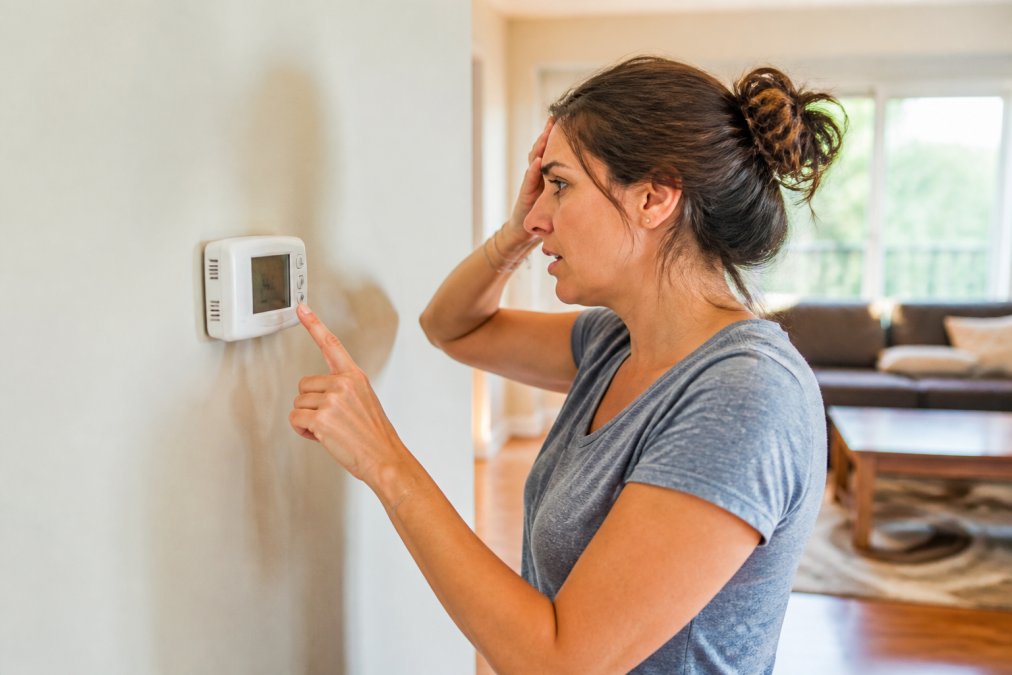
Other warning signs that warrant same-day attention include:
- Loud banging, grinding, or screeching sounds from the air handler or outdoor condenser
- Water pooling around the indoor unit, signaling a blocked condensate drain or frozen coil
- Inconsistent temperatures across rooms despite correct thermostat settings
- Weak or no airflow from supply vents
- A system that cycles on and off every few minutes without completing a full run
Any single one of these can indicate a problem that will compound quickly.
What to Check Before You Call a Technician
Before calling, a quick self-check can save you a service call or help the technician diagnose faster. This is not about DIY repair, it's about ruling out the obvious.
Check these first:
- Thermostat settings: Confirm the system is set to "cool" or "heat" (not "fan only") and the temperature is set correctly.
- Air filter: A completely clogged filter can cause the system to shut down on thermal overload. If visibly gray and packed with debris, replace it and wait 30 minutes before restarting.
- Circuit breaker: Check for a tripped breaker labeled "AC," "HVAC," or "air handler." Reset it once. If it trips again immediately, call a technician, a repeatedly tripping breaker signals an electrical fault.
- Outdoor unit: Ensure the condenser isn't blocked by debris, overgrown vegetation, or a cover. The unit needs clear airflow on all sides.
- Condensate drain line: If you see water around the indoor unit, check whether the drain pan is overflowing.
If none of these resolve the issue, you're dealing with a mechanical or refrigerant problem requiring a certified technician. Don't run the system repeatedly if it's not working.
Air CareSaver: Emergency HVAC Repair and Same-Day Dispatch
Air CareSaver is a family-owned and licensed HVAC contractor serving the San Gabriel Valley and surrounding communities, with over 21 years of experience and California contractor license #1054832. The company offers same-day response and free estimates on all service calls.
What separates Air CareSaver is its diagnostic approach. Many HVAC companies identify the most expensive possible repair and quote it. Air CareSaver's technicians find the actual cause of failure, not the most profitable one. That means accurate diagnostics without unnecessary parts or guesswork.
The 4.9 Google rating across 270+ reviews reflects that consistency. When a family in Walnut has no AC at 9 PM in August, they need someone who shows up, diagnoses correctly, and fixes the problem.
Residential HVAC Solutions for Homes and Older Properties
Older homes in the San Gabriel Valley present specific challenges. Properties built in the 1970s and 1980s often have original duct systems not designed for modern high-efficiency equipment, oversized or undersized systems, mixed refrigerant types, or ductwork that's lost insulation and sealing over decades.
The question many homeowners ask: is it worth fixing an older system, or should I replace it? The answer depends on the specific failure. A compressor replacement on a 15-year-old system rarely makes financial sense. A capacitor replacement or refrigerant recharge might buy several more years of reliable service. Air CareSaver's technicians assess both the immediate repair cost and the system's remaining service life before recommending a path forward.
For homes upgrading to energy-efficient systems, proper sizing and duct assessment matter as much as equipment selection. An undersized unit runs constantly and never reaches setpoint. An oversized unit short-cycles, leaving the home humid and uncomfortable.
Commercial HVAC Repair for Offices and Businesses
Commercial HVAC failures carry different urgency. A small office with a failed rooftop unit isn't just uncomfortable, it's a productivity problem, a potential health and safety issue, and depending on the business, a liability concern.
Commercial systems are more complex than residential units: rooftop package units, split systems, variable refrigerant flow systems, and building automation controls all require technicians with commercial HVAC experience. Air CareSaver provides same-day dispatch for commercial clients, with diagnostics focused on restoring operations quickly.
HVAC Repair Cost Estimate: What Affects Your Final Bill
HVAC repair costs vary significantly based on the type of failure, the age and brand of equipment, parts availability, and whether the repair happens during standard hours or as an after-hours emergency call.
According to the Air-Conditioning, Heating, and Refrigeration Institute's consumer resources, system complexity and local labor rates are the two biggest drivers of repair cost variation. Here's what determines your bill:
| Factor | Lower Cost Impact | Higher Cost Impact |
|---|---|---|
| Type of failure | Capacitor, contactor, filter, drain | Compressor, heat exchanger, refrigerant leak |
| System age | Under 10 years | Over 15 years (parts harder to source) |
| Service timing | Standard business hours | After-hours, weekend, holiday |
| Equipment type | Standard residential split | Commercial rooftop, variable refrigerant flow |
| Parts availability | Common OEM parts in stock | Specialty or discontinued components |
A legitimate contractor will diagnose first and quote before performing any work. If a technician quotes a major repair without proper diagnostic, that's a red flag. Air CareSaver provides free estimates, so you know the cost before any work begins.
Certified Technicians, Licensed Service, and Proven Results
Licensing matters in HVAC more than most homeowners realize. California requires HVAC contractors to hold a valid C-20 Warm-Air Heating, Ventilating and Air-Conditioning contractor license, issued by the Contractors State License Board. Working with an unlicensed technician voids equipment warranties, creates liability issues, and offers no recourse if work is done incorrectly.
Air CareSaver holds California contractor license #1054832, which can be verified directly through the California Contractors State License Board's public license lookup. That's the baseline requirement for legal HVAC work in the state.
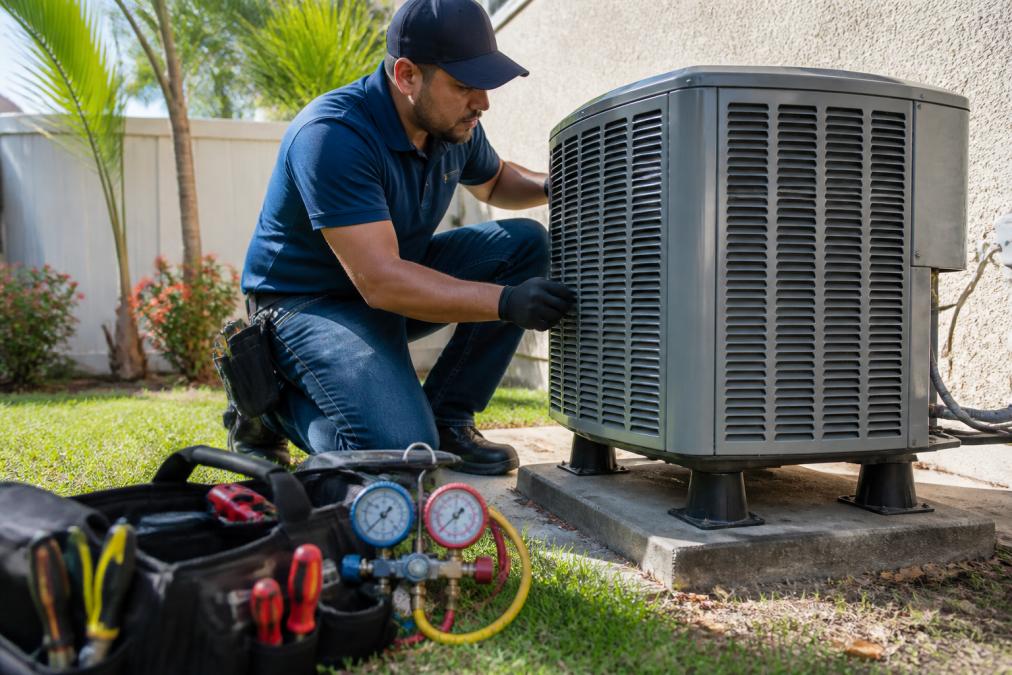
Quality technicians diagnose with gauges, measure system pressures, check electrical components with a multimeter, and inspect heat exchangers before quoting repairs. Air CareSaver's 21+ years of operation in the San Gabriel Valley and 4.9 rating across 270+ Google reviews reflect a consistent track record built on showing up, diagnosing accurately, and fixing what's actually broken.
Preventative Maintenance Plans to Avoid the Next Emergency
The most expensive HVAC repair is the one that could have been prevented. Most system failures develop over months: a capacitor weakening, refrigerant slowly leaking, a heat exchanger developing a crack, a blower motor bearing wearing down. A technician performing a proper tune-up catches these early.
A standard HVAC maintenance plan typically covers two visits per year: one before cooling season and one before heating season. Each visit includes system inspection, cleaning of key components, electrical connection checks, refrigerant level verification, and a report on any developing issues.
The practical value of preventative maintenance:
- Extends equipment life: Systems receiving regular maintenance consistently outlast neglected systems by several years
- Maintains efficiency: A clean, properly charged system uses less energy, showing up directly in utility bills
- Catches failures before they cascade: A $150 capacitor replacement discovered during a tune-up prevents a $1,500 compressor failure six weeks later
- Preserves manufacturer warranties: Many equipment warranties require documented annual maintenance to remain valid
According to the U.S. Environmental Protection Agency's ENERGY STAR guidance on HVAC maintenance, regular maintenance is one of the most cost-effective ways to reduce energy consumption in residential buildings.
Air CareSaver offers preventative maintenance plans for both residential and commercial clients, with scheduling options that fit around business operations and family schedules. The goal is straightforward: catch problems before they become emergencies, keep systems running efficiently, and give homeowners and property managers one less thing to worry about.
Frequently Asked Questions
What qualifies as an emergency HVAC repair?
An HVAC situation becomes an emergency when your system stops working entirely during extreme heat or cold, when you detect burning smells or unusual sounds pointing to electrical or mechanical failure, or when a refrigerant leak is suspected. For households with elderly residents, young children, or medical conditions, a complete system outage at any temperature qualifies. Air CareSaver provides same-day dispatch so you are not waiting days for relief during a genuine system failure.
How much does emergency HVAC repair cost?
Emergency HVAC repair costs vary based on the type of failure, parts required, and whether the call falls outside standard business hours. Common issues like thermostat replacement or refrigerant recharge cost far less than a compressor failure or full system replacement. Air CareSaver offers free estimates so you know what you are paying before any work begins. Contact the team directly for an accurate HVAC repair cost estimate specific to your system and situation.
How quickly can an emergency HVAC technician arrive?
Air CareSaver commits to same-day response for emergency HVAC repair requests in the San Gabriel Valley service area. Response times depend on your location and current dispatch volume, but the team prioritizes urgent calls, including after-hours service, to minimize downtime for both residential and commercial customers. Calling as early as possible in the day increases the likelihood of a morning or early-afternoon arrival.
What should I check before calling for emergency HVAC repair?
Before calling, check that your thermostat is set correctly and has working batteries, confirm the circuit breaker for your HVAC unit has not tripped, and make sure all air vents are open and unobstructed. Also inspect your air filter, a severely clogged filter can cause the system to shut down entirely. If none of these steps restore operation, contact a certified technician. Attempting to reset a system with a refrigerant leak or compressor failure without professional help can cause further damage.
Is a broken AC considered an emergency during summer?
Yes, especially during the San Gabriel Valley's peak summer heat when daytime temperatures regularly exceed 90°F. A non-functioning air conditioning system in those conditions poses real health risks, particularly for elderly residents and young children. Most HVAC contractors, including Air CareSaver, treat complete cooling system outages during high-heat periods as priority emergency calls and offer after-hours service to address them the same day.
Choosing an HVAC contractor during an emergency is stressful. The system is down, the house is uncomfortable, and you're trying to make a fast decision about a company you may have never worked with before. Air CareSaver makes that decision easier: 21+ years of licensed experience, same-day dispatch, free estimates, and a 4.9 Google rating from 270+ real customers in the San Gabriel Valley. Get My Free Quote and have a certified technician at your door today.
This article was written using GrandRanker