 how-to
Commercial HVAC Repair: A How-To Guide
Table of Contents
- When to Call for Commercial HVAC Repair
- Signs of Commercial HVAC Failure You Can't Ignore
- Emergency HVAC Repair in the San Gabriel Valley: What to Expect
- Commercial HVAC Maintenance Checklist for Business Owners
- Diagnosing Common Commercial HVAC Problems
- How to Extend Your System's Life and Avoid Expensive Repairs
- Getting the Right Professional Help for Your Business
- Frequently Asked Questions
Last Updated: August 22, 2026
When to Call for Commercial HVAC Repair
Your commercial HVAC system runs fine until it doesn't. One moment your office is comfortable, the next your tenants are calling about temperature swings or no cooling. The question isn't whether you'll need repair, it's whether you'll catch the problem before it becomes catastrophic.
Most business owners wait too long, assuming minor fluctuations will resolve themselves or hoping to avoid service costs. That hesitation is expensive. A struggling system works harder, consumes more energy, and moves closer to complete failure. The difference between calling for service today and waiting until next week is often the difference between a repair and a replacement.
At Air CareSaver, we've seen this pattern repeat across commercial properties throughout the region. Businesses that schedule service early spend less than those who wait for breakdown. A preventative service call might cost a few hundred dollars. An emergency repair at 2 AM on a weekend, when your system has failed completely, costs much more.
Triggers for an actual service call: your system isn't maintaining setpoint temperature, you're hearing unusual noises, you're seeing visible leaks, or your energy bills have jumped without explanation. These aren't minor issues. They're signals that something inside your system has shifted. The sooner you get a licensed technician to diagnose what's happening, the sooner you can make an informed decision about repair versus replacement.
Signs of Commercial HVAC Failure You Can't Ignore
Commercial HVAC systems fail in patterns. Understanding those patterns helps you recognize when you're moving from "running but not optimal" to "needs immediate attention."
Temperature inconsistency across zones is an early warning. Your front office stays comfortable while the back conference room runs hot, or vice versa. This usually points to ductwork problems, a collapsed section, a damper stuck in the wrong position, or a failing compressor that can't maintain consistent pressure.
Unusual sounds deserve attention. A commercial HVAC system should run quietly. Grinding noises often mean a bearing is wearing out. Squealing suggests a belt is slipping or a refrigerant line is vibrating. Rattling can indicate loose components or debris inside the system. These noises don't resolve; they get worse until the component fails completely.
Visible refrigerant leaks are non-negotiable. If you see oily residue around pipe connections or pooling liquid near the outdoor unit, your system is losing refrigerant. This reduces cooling capacity and forces the compressor to work harder. Refrigerant leaks require immediate professional attention.
Energy bills that spike without explanation indicate your system is running longer cycles to achieve the same output. A 15-20% increase in cooling costs usually means something has shifted mechanically.
Weak or no airflow from vents is a red flag. This could be a clogged filter, a failing air handler motor, or a blockage in the ductwork. If changing the filter doesn't restore airflow, you need diagnostics from a licensed technician.
Systems show warning signs before they fail completely. Ignoring those signs is expensive.
Emergency HVAC Repair in the San Gabriel Valley: What to Expect
When your commercial HVAC system fails during business hours or outside business hours, you need a response that matches the urgency. An office without cooling in summer isn't just uncomfortable; it's a business disruption.
Same-day response matters. Many HVAC companies quote 24-48 hours for emergency service. By then, your building has been without climate control for a full day or more. Air CareSaver prioritizes same-day emergency response because downtime costs you money. A technician arriving the same day you call can diagnose the problem, explain your repair options, and often complete the fix before your business closes.
When a technician arrives, the diagnostic comes first. A licensed professional will check your thermostat settings, inspect the outdoor unit, listen to the system running, and measure airflow and temperature at key points. This diagnostic reveals whether you're dealing with a simple fix, a tripped breaker, a clogged filter, a thermostat setting, or a component failure that requires parts and time.
For emergency calls, the diagnostic is most valuable. You'll know exactly what's wrong and what it costs to fix. No guessing. Accurate diagnostics prevent unnecessary spending and downtime.
Most commercial HVAC emergencies fall into a few categories: compressor failure, refrigerant leaks, electrical issues, or thermostat malfunction. Some can be repaired in a few hours. Others require parts that need to be ordered. A technician who arrives the same day can tell you which situation you're in and what timeline to expect.
Commercial HVAC Maintenance Checklist for Business Owners
Preventative maintenance is the difference between systems that run for 15-20 years and systems that fail at 10 years (ashrae.org). It's also the difference between predictable maintenance costs and emergency repair bills.
Monthly tasks are simple and often handled by facility staff. Check your thermostat settings to confirm they match your building's schedule. Inspect the outdoor unit for visible debris, leaves, or obstructions. Look at the area around the indoor air handler for standing water or unusual odors.
Quarterly inspections require a licensed technician. Air filters need replacement every 90 days in most commercial settings, more often if your building is dusty or has heavy foot traffic (ashrae.org). A technician will also check refrigerant levels, test electrical connections, and verify that all components are operating within normal parameters.
Annual tune-ups are comprehensive. A full system inspection includes checking the compressor, inspecting all electrical connections, cleaning the condenser coil, verifying thermostat calibration, testing airflow throughout the ductwork, and checking for refrigerant leaks. An annual tune-up typically takes 2-3 hours and costs a fraction of an emergency repair.
| Maintenance Task | Frequency | Who Does It | Why It Matters |
|---|---|---|---|
| Filter replacement | Monthly to quarterly | Facility staff or technician | Maintains airflow and system efficiency |
| Outdoor unit inspection | Monthly | Facility staff | Catches debris and obstructions early |
| Refrigerant level check | Quarterly | Licensed technician | Prevents compressor damage |
| Electrical connection test | Annually | Licensed technician | Prevents system failure and safety issues |
| Condenser coil cleaning | Annually | Licensed technician | Maintains heat transfer and efficiency |
| Thermostat calibration | Annually | Licensed technician | Ensures accurate temperature control |
| Ductwork inspection | Every 2-3 years | Licensed technician | Identifies leaks and blockages |
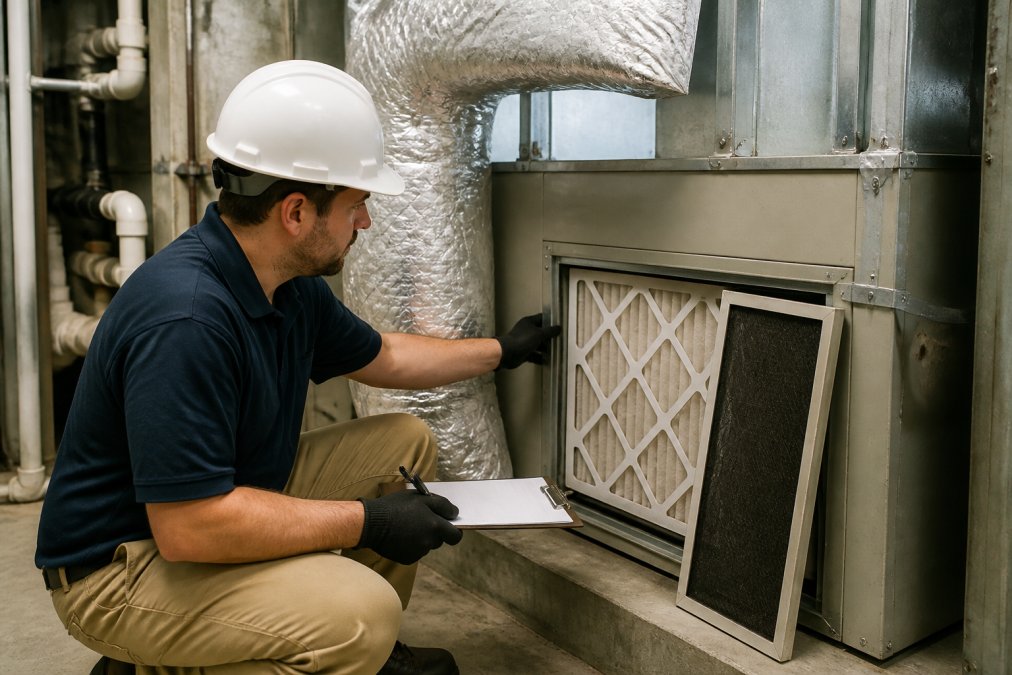
Preventative maintenance plans typically include quarterly service visits and annual tune-ups. The cost is predictable, and the benefit is clear: your system stays reliable, your energy costs stay reasonable, and you avoid emergency repairs.
Consistency is key. A system serviced every quarter runs differently than one ignored for two years then serviced once. Consistent maintenance keeps components in balance and catches drift before it becomes failure.
Diagnosing Common Commercial HVAC Problems
When your system isn't performing, diagnosis is the first step. Accurate diagnosis tells you exactly what's failing and whether it's worth repairing.
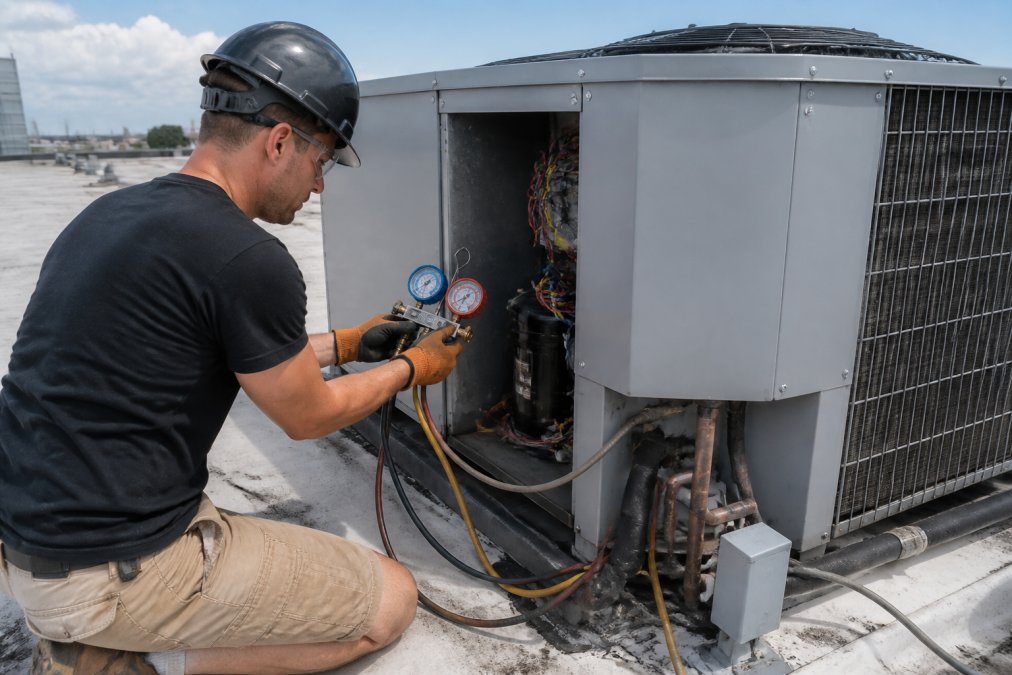
Compressor issues are among the most common failures in commercial systems. The compressor pressurizes refrigerant and circulates it through the system. When a compressor weakens, it can't maintain pressure, so cooling capacity drops. You might notice that your system runs constantly but never reaches setpoint temperature. A technician will check refrigerant pressure and temperature at different points in the system. If pressures are abnormal, the compressor is likely failing. Compressor replacement is a significant expense, but proper diagnosis confirms whether it's actually the problem.
Refrigerant leaks reduce system capacity and force the compressor to work harder. A technician uses electronic leak detection equipment to pinpoint where refrigerant is escaping. Once the leak is found and repaired, the system needs a refrigerant recharge. This is necessary to restore function.
Thermostat malfunction is often misdiagnosed as a system failure. If your thermostat isn't reading temperature accurately or isn't communicating with the system, your HVAC won't respond to demand. A technician will test the thermostat's sensor, verify its wiring, and confirm it's communicating with the control board. Sometimes recalibration solves it; sometimes the thermostat needs replacement. This is usually a lower-cost fix than compressor or refrigerant issues.
Ductwork problems prevent conditioned air from reaching certain zones. Ducts can develop leaks, collapse partially, or become blocked by debris. A technician can test airflow at different registers and use tools to visualize what's happening inside the ductwork.
Electrical failures stop the system entirely or prevent it from starting. A tripped breaker, a failed contactor, or a broken capacitor can disable cooling. These are usually straightforward to diagnose and repair.
Accurate diagnosis prevents you from replacing parts that aren't actually failing. It also prevents you from limping along with a system that's about to fail completely.
How to Extend Your System's Life and Avoid Expensive Repairs
Commercial HVAC systems last 15-20 years if they're maintained (the EPA). They last 8-10 years if they're ignored.
Keep the outdoor unit clear. Debris, leaves, grass clippings, and dirt reduce airflow through the condenser coil. This forces the compressor to work harder. A simple monthly inspection and cleanup takes 10 minutes and extends system life significantly.
Replace filters on schedule. A clogged filter restricts airflow and forces the air handler motor to work harder. Most commercial buildings need filter changes every 90 days, but buildings with heavy dust loads might need monthly changes. A clean filter keeps airflow consistent and reduces strain on the system.
Schedule maintenance before peak season. Summer cooling demand is when failures happen. Schedule your annual tune-up in spring, before the heat arrives. A tune-up in May costs far less than an emergency repair in July.
Monitor energy bills. If your cooling costs jump 15-20% without explanation, something has shifted mechanically. A technician can diagnose the cause before it becomes a major failure.
Don't defer repairs. A small refrigerant leak gets bigger. A worn bearing gets worse. Early intervention is always cheaper.
Consider a maintenance plan. A service agreement that includes quarterly inspections and annual tune-ups costs less than emergency repairs and keeps your system running predictably.
Systems that are maintained run longer and cost less to operate. Systems that are neglected fail faster and cost more to fix.
Getting the Right Professional Help for Your Business
Not all HVAC companies are equivalent. Licensing, experience, and responsiveness vary widely. Choosing the right contractor prevents you from overpaying for unnecessary work or waiting days for emergency service.
Verify licensing. A licensed HVAC contractor has passed exams, maintains continuing education, and is accountable to regulatory boards. California licensing (#1054832 for reference) is a baseline requirement. Ask for the license number and verify it independently if you want to confirm the company's standing.
Ask about emergency response. How quickly can they arrive for an emergency call? Can they handle commercial systems, or do they primarily service residential units? A contractor experienced with commercial rooftop units and large-capacity systems is more likely to diagnose and fix your problem quickly.
Get a free diagnostic. A reputable contractor will provide a free estimate for diagnostic work. This gives you a clear picture of what's wrong before you commit to repairs.
Ask for references. How long have they been in business? Do they have references from other commercial properties in your area? A company with strong local references is more reliable.
Understand the warranty. What warranty do they offer on repairs? A company that stands behind their work offers both parts and labor warranties.
Air CareSaver has been serving commercial and residential properties throughout the San Gabriel Valley for over 21 years. We're family-owned, licensed (#1054832), and committed to same-day response for emergencies. Our technicians provide accurate diagnostics without unnecessary upselling, and we back every repair with a warranty. We also offer free estimates so you know exactly what a repair costs before you decide.
The difference between a business that experiences a brief HVAC disruption and one that loses a full day of operations often comes down to one thing: having a trusted contractor on speed dial. When your system fails, you don't have time to shop around or wait for callbacks. You need someone who answers the phone, arrives the same day, diagnoses accurately, and fixes the problem. Call Air CareSaver for a free quote and let us show you how reliable commercial HVAC service should work. Get My Free Quote and see why 270+ local businesses trust us to keep their systems running.
Frequently Asked Questions
Q: What are the signs that my commercial HVAC system needs professional repair?
A: Watch for reduced cooling or heating output, unusual noises from the compressor or air handler, higher energy bills without explanation, visible leaks around refrigerant lines, and difficulty maintaining consistent temperatures across your space. These indicate problems that require professional diagnostics. Ignoring these signs often leads to complete system failure and expensive emergency repairs.
Q: How often should I perform preventative maintenance on my commercial HVAC system?
A: Most commercial systems benefit from preventative maintenance twice yearly: once before cooling season and once before heating season. A preventative maintenance plan typically includes filter replacement, refrigerant checks, coil cleaning, thermostat calibration, and system diagnostics. Regular preventative care extends equipment life, improves energy efficiency, and prevents unexpected breakdowns that disrupt business operations.
Q: Can I troubleshoot my commercial HVAC system myself before calling a technician?
A: You can perform basic checks: verify the thermostat is set correctly, inspect visible filters and replace if clogged, check that outdoor condenser units are clear of debris, and listen for unusual sounds. However, commercial HVAC troubleshooting involving refrigerant, electrical components, or ductwork requires licensed professionals with proper diagnostic equipment. Attempting repairs yourself can void warranties and create safety hazards.
Q: What should I expect during an emergency HVAC repair visit?
A: A professional technician will arrive with diagnostic tools to identify the exact problem, explain what's wrong and why, and discuss repair options and costs before proceeding. They'll focus on restoring your system quickly to minimize business disruption. Same-day response means a technician can often assess and repair issues the same day, especially for critical commercial failures affecting your climate control.
This article was written using GrandRanker