 ultimate-guide
Commercial HVAC Maintenance Contract Pricing: 2026 Guide
Table of Contents
- What Is a Commercial HVAC Maintenance Contract?
- Types of Commercial HVAC Service Plans
- Factors Influencing Commercial HVAC Maintenance Pricing
- Average Annual Cost Per Square Foot
- Building a Commercial HVAC Maintenance Checklist
- Understanding Your HVAC Service Agreement Template
- How to Choose the Right HVAC Contractor
- Frequently Asked Questions
Last Updated: August 15, 2026
What Is a Commercial HVAC Maintenance Contract?
A commercial HVAC maintenance contract is a service agreement between a business and an HVAC provider that establishes regular inspections, preventative maintenance, and repair protocols for heating, ventilation, and air conditioning systems. These contracts define what work will be performed, how often service visits occur, what equipment is covered, and what costs the business will incur.
For commercial property managers, these agreements are essential risk management tools. They shift equipment failures from unpredictable emergencies to scheduled, budgeted maintenance. A properly structured contract becomes your facility's insurance policy against operational disruptions and extends equipment lifespan.
Types of Commercial HVAC Service Plans
Commercial HVAC service plans fall into distinct categories, each with different cost structures and coverage levels.
Preventative Maintenance vs. Reactive Repairs
Preventative maintenance involves scheduled service visits on a fixed calendar, typically quarterly, biannual, or annual, to inspect, clean, and optimize your HVAC system before problems develop. These visits include filter replacement, coil cleaning, refrigerant level checks, and system diagnostics.
Reactive repairs mean you call a contractor only when something breaks. You pay per service visit, per hour of labor, and for parts as needed. Preventative maintenance spreads costs predictably throughout the year, while reactive repairs concentrate costs into crisis moments when emergency service charges apply. Most commercial property managers find that preventative maintenance reduces total annual spending while eliminating the uncertainty of emergency repair bills.
Full-Coverage Agreements vs. Labor-Only Plans
Full-coverage agreements include parts, labor, refrigerant, filters, and diagnostics. You pay a fixed annual or monthly fee with minimal additional charges.
Labor-only plans cover the technician's time and expertise but not parts or materials. Full-coverage agreements work best for older equipment or systems with higher failure risk. Labor-only plans suit newer systems in good condition where major repairs are unlikely.
Factors Influencing Commercial HVAC Maintenance Pricing
Several variables determine what you'll pay for a commercial HVAC maintenance contract.
System size and capacity is the primary cost driver. Larger commercial buildings require more labor per service visit and more refrigerant for seasonal adjustments.
Equipment age and condition affects both contract pricing and repair frequency. Newer systems may qualify for reduced service rates, while older systems require more intensive inspections and carry higher parts replacement risk.
Service visit frequency determines total annual cost. Monthly inspections cost more than quarterly visits, which cost more than annual inspections. A facility running HVAC systems 24/7 needs more frequent monitoring than one with standard business-hour operation.
Regional labor rates vary significantly across the country. Local competition, technician licensing requirements, and cost of living all influence what contractors charge per hour.
Contract scope and coverage determines pricing structure. Emergency service priority, extended hours availability, and parts and materials coverage each increase the annual fee.
Diagnostic and testing services included in the contract affect pricing. Comprehensive system diagnostics and efficiency testing cost more than basic visual inspections but identify problems earlier.
Average Annual Cost Per Square Foot
Commercial HVAC maintenance contracts typically range based on facility size and coverage level. Smaller commercial spaces often have higher per-square-foot costs because the fixed overhead of a service visit spreads across fewer square feet.
Full-coverage agreements with quarterly preventative maintenance visits generally cost more per square foot than labor-only plans with annual inspections. Building age matters significantly, newer commercial construction with modern HVAC systems costs less to maintain than older buildings with aging equipment.
Request quotes from multiple contractors specifying your exact building size, equipment details, desired service frequency, and coverage preferences to allow direct comparison.
Building a Commercial HVAC Maintenance Checklist
A commercial HVAC maintenance checklist documents the specific inspections, tests, and adjustments that should occur during each service visit.
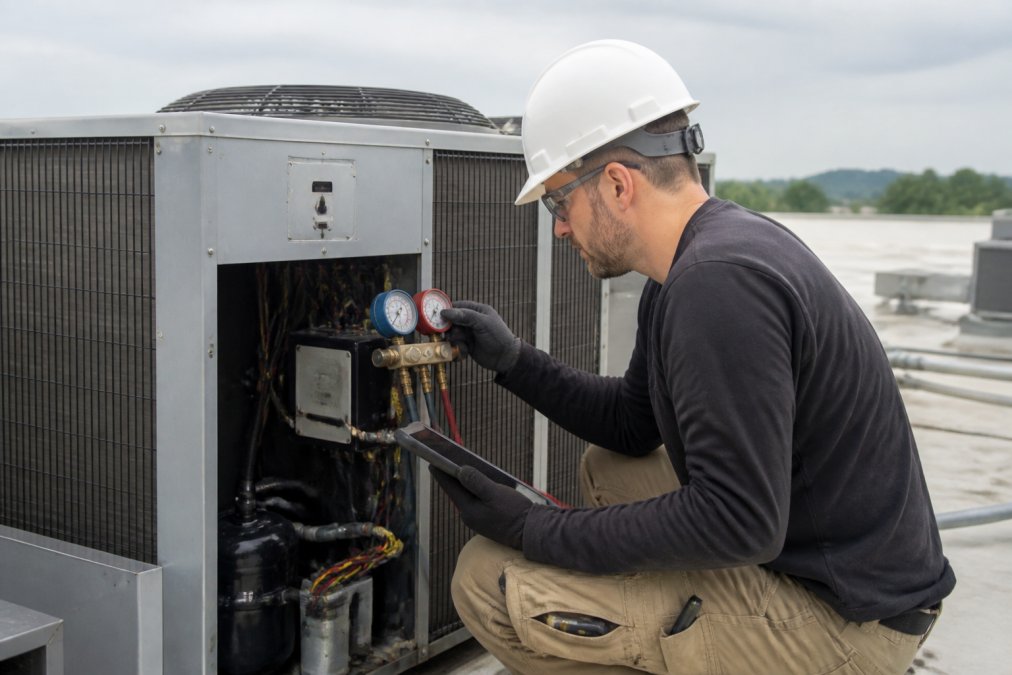
Essential checklist items include visual inspection of all accessible components, filter condition assessment and replacement, coil cleaning, refrigerant level verification, electrical connection tightness checks, thermostat calibration testing, and ductwork inspection for leaks or damage.
System diagnostics should measure supply and return air temperatures, check airflow velocity across coils, test electrical components for proper operation, and verify that the system cycles appropriately. Document baseline performance metrics to track changes over time.
Create a maintenance log that records every service visit, what work was performed, parts replaced, performance measurements taken, and any issues identified. Digital maintenance tracking systems have become standard in commercial facility management, automating service visit logging, sending reminder notifications, tracking parts inventory, and generating performance reports.
Understanding Your HVAC Service Agreement Template
Before signing any HVAC service agreement template, understand what each section means and what obligations it creates for both parties.
The scope of work section defines exactly what the contractor will do. "Quarterly filter replacement, coil cleaning, refrigerant level checks, and system diagnostics" is specific and prevents misunderstandings.
The coverage section specifies what equipment is included. Does it cover all HVAC units on the property, or only certain systems? Are backup units and supplemental heating or cooling equipment included?
The response time section establishes how quickly the contractor will arrive for emergency service calls. Same-day response differs significantly from 24-hour response.
The pricing section should specify whether costs are fixed or variable. Fixed pricing provides budget certainty, while variable pricing tied to parts costs introduces uncertainty.
Contract Termination and Exit Clauses
Termination clauses define how either party can end the agreement. Some contracts lock you in for a full year with penalties for early termination, while others allow 30-day cancellation with written notice.
Fair termination clauses typically allow either party to exit with 30 to 60 days' notice after an initial contract period of one year. This protects both sides while preventing long-term entrapment in an unsatisfactory relationship.
Digital Maintenance Tracking and Software Integration
Modern commercial HVAC service agreements increasingly include digital tools for tracking maintenance history, scheduling future visits, and monitoring system performance.
These platforms provide automated reminders to ensure preventative maintenance never gets overlooked, centralize service records for easy access, and analyze performance data to identify trends like gradual refrigerant loss or declining efficiency.
Ask whether your contractor's platform integrates with your facility management system. Some agreements include remote monitoring capabilities where sensors installed on your HVAC equipment transmit real-time data to the contractor's system, allowing early detection of problems before they cause system failure.
How to Choose the Right HVAC Contractor
Selecting a contractor is as important as selecting the contract type.

Start by verifying licensing and credentials. Every technician should hold current EPA certification for handling refrigerants. The company should carry appropriate insurance and provide verifiable license numbers.
Check references from other commercial clients. Ask how responsive the contractor is to emergency calls, whether they show up on time for scheduled maintenance, and how they handle disputes over repair necessity.
Evaluate their diagnostic approach. Do they explain what they find and why repairs are necessary? Do they provide written estimates before starting work?
Compare pricing across multiple contractors, but don't select solely on lowest cost. The cheapest contract often excludes important services or uses lower-quality parts. A mid-range contractor offering comprehensive service and transparent pricing typically delivers better value.
Assess communication and responsiveness. Can you reach them by phone, email, or online portal? A contractor that's hard to reach during normal business hours will be harder to reach during emergencies.
Consider whether they offer same-day response capability. For commercial facilities where HVAC failure disrupts operations, same-day emergency response prevents extended downtime.
Choosing a commercial HVAC maintenance contract requires balancing cost, coverage, and contractor reliability. The goal isn't finding the cheapest option, it's finding the contractor and contract structure that prevents costly equipment failures, maintains system efficiency, and provides reliable service when you need it.
Air CareSaver brings 21 years of experience maintaining commercial HVAC systems across the San Gabriel Valley. We offer transparent pricing, same-day response to emergency calls, free estimates, and comprehensive maintenance agreements designed to protect your facility's comfort and operational reliability. Our licensed technicians provide accurate diagnostics without unnecessary upselling, and our preventative maintenance programs extend equipment lifespan while reducing energy costs.
Get your free quote today and discover how the right maintenance contract protects your facility's climate control investment.
| Service Plan Type | Best For | Coverage Level | Typical Frequency |
|---|---|---|---|
| Labor-Only Plan | Newer systems in good condition | Service visits and diagnostics only | Annual or as-needed |
| Preventative Maintenance | Facilities requiring budget certainty | Quarterly inspections and routine service | Quarterly visits |
| Full-Coverage Agreement | Older equipment or high-use facilities | Parts, labor, diagnostics, emergency priority | Quarterly or biannual |
| Emergency-Only Service | Budget-conscious operations with low failure risk | Service calls only when problems occur | As-needed basis |
Frequently Asked Questions
What should be included in a commercial HVAC maintenance contract?
A comprehensive commercial HVAC maintenance contract typically includes regular system inspections, filter replacement, coil cleaning, refrigerant level checks, and emergency service priority. The scope varies by agreement type. Full-coverage agreements cover parts and materials, while labor-only plans cover technician time. Most contracts specify service visit frequency, equipment covered, and response time for emergency calls. Your contract should clearly outline what's included, what's excluded, and any additional fees for services beyond the agreement scope.
How is commercial HVAC maintenance cost per ton calculated?
Commercial HVAC maintenance cost per ton depends on your system's capacity, equipment age, facility size, and service complexity. Contractors factor in labor rates, parts availability, and regional market conditions. Annual maintenance contracts typically range based on tonnage and service level. To get an accurate cost per ton for your specific facility, request a free estimate that breaks down pricing by equipment size and service scope. This helps you compare fairly across different contractors and plan your facility management budget.
Are commercial HVAC maintenance contracts worth the investment?
Yes, preventative maintenance agreements reduce unexpected breakdowns, extend equipment lifespan, and improve HVAC system efficiency. Planned maintenance prevents costly operational downtime and emergency service calls. Regular system diagnostics catch problems early before they become expensive repairs. Many businesses find that the predictable cost of an annual maintenance contract is far less than emergency repairs or premature equipment replacement. The key is choosing a contract that matches your facility's needs and equipment condition.
What's the difference between a full-coverage agreement and a labor-only plan?
A full-coverage agreement includes parts, materials, and labor for scheduled maintenance and often covers emergency repairs. A labor-only plan covers technician time but you pay separately for parts and materials. Full-coverage agreements provide more predictable budgeting and typically offer better value for older systems or facilities with higher maintenance needs. Labor-only plans suit businesses with newer equipment or lower service requirements. Review your equipment age, usage patterns, and budget constraints when choosing between these contract types.
This article was written using GrandRanker