 ultimate-guide
SEER Rating for AC Explained: What It Means for You
Table of Contents
- What Is a SEER Rating? The Basics Explained
- SEER vs SEER2 Explained: What Changed and Why It Matters
- Minimum SEER2 Requirements by Region: What Your State Allows
- What Counts as a Good SEER Rating for Your Home?
- How to Calculate AC Energy Savings from a Higher SEER Rating
- How Maintenance Affects Your SEER Rating Over Time
- Frequently Asked Questions
Last Updated: October 1, 2026
What Is a SEER Rating? The Basics Explained
A SEER rating is the measure of how efficiently an air conditioner converts electricity into cooling over an entire cooling season. SEER stands for Seasonal Energy Efficiency Ratio, and it is calculated by dividing total cooling output in BTU by the electric energy input in watt-hours. Higher numbers mean less power consumption for the same comfort.
SEER vs SEER2 Explained: What Changed and Why It Matters
SEER2 is the updated federal test procedure that replaced the original SEER metric in 2023, and it produces slightly lower numbers for the same equipment. The change came from the DOE, which revised testing conditions to better reflect real-world installation setups, including higher external static pressure on the duct system.
How SEER2 Testing Differs from the Original SEER
The original test assumed a duct system with minimal resistance. SEER2 testing adds static pressure that mirrors what most installed systems actually see. Because real ductwork, filters, and coils create resistance, the SEER2 number is a more honest predictor of performance in your home. When you compare quotes, never mix the two metrics.
Minimum SEER2 Requirements by Region: What Your State Allows
Minimum SEER2 requirements depend on where you live, and the map splits the country into three zones. The DOE sets these standards, and they differ by region because hotter climates run cooling systems far more hours per year:
- North: 13.4 SEER2 for most split systems
- Southeast and Southwest: 14.3 SEER2 for split systems, with higher thresholds for some equipment classes
- Heat pump variants: separate minimums that differ from straight cooling units
Why the Same Unit Can Have Two Different Ratings
Manufacturers often list both SEER and SEER2 on the same spec sheet. The SEER figure satisfies older marketing comparisons; the SEER2 figure reflects the current legal standard. If a salesperson quotes only the higher number, ask for the SEER2 rating in writing.
| Metric | Test Conditions | Typical Number | Still Legal to Sell? |
|---|---|---|---|
| SEER | Lower static pressure | Higher | Legacy reference only |
| SEER2 | Realistic static pressure | Lower | Yes, current standard |
| EER2 | Peak-load conditions | Separate scale | Yes, hot-climate metric |
What Counts as a Good SEER Rating for Your Home?
A good SEER rating is one that meets your regional minimum and matches how hard your system actually works. In the San Gabriel Valley, where cooling season stretches long, stepping above the minimum usually pays back faster than it would in a milder climate.
- At the minimum: legal, functional, cheapest upfront
- Mid-tier: meaningful energy savings without premium pricing
- Top-tier: best for homes with high runtime hours or rooms that never quite cool
How to Calculate AC Energy Savings from a Higher SEER Rating
Most guides stop at the ratio trick: divide your old SEER2 by the new SEER2 and multiply by your annual cooling cost. That gets you a rough number, but it ignores the variables that decide whether an upgrade actually pays for itself. Here is a fuller method to consider.
Step 1: Estimate Your Annual Cooling Cost
If you do not already know it, pull twelve months of electric bills and isolate the cooling portion. A common shortcut is to take your summer cooling-season bills (typically June through September in most climates), subtract your non-summer baseline months, and add the difference. For a typical single-family home running a central system, cooling often accounts for a meaningful share of summer electricity use, the exact figure depends on your rate, thermostat habits, and envelope.
Step 2: Apply the SEER2 Ratio
Annual cooling cost × (old SEER2 ÷ new SEER2) = projected new cooling cost.
Step 3: Adjust for Real-World Factors
The ratio assumes the new system is installed and commissioned correctly. In practice, three adjustments matter:
- Duct leakage. The DOE has estimated that typical homes lose a meaningful fraction of conditioned air through leaks and poor connections. If your ducts leak, a portion of your theoretical savings never reaches the living space.
- Runtime hours. Savings scale with how many hours the system actually runs. A home in a hot, long cooling season captures more of the ratio; a mild-climate home captures less.
- Sizing and airflow. An oversized system short-cycles, which erodes efficiency and humidity control. A properly sized, correctly charged system delivers closer to its rated number.
Step 4: Calculate Payback Period
Payback (years) = installed price difference ÷ annual savings.
If the higher-SEER2 upgrade costs $3,000 more than the minimum-efficiency option and saves $450 per year, payback is roughly 6.7 years. Central AC equipment commonly lasts 12 to 15 years with proper maintenance, so the math usually favors the upgrade, but only if the assumptions above hold.
A Quick Sensitivity Check
Before you commit, run the same math at half the estimated savings. If payback still lands inside the expected equipment life, the upgrade is defensible. If it does not, the premium may not be worth it for your usage pattern.
How Maintenance Affects Your SEER Rating Over Time
A SEER2 rating is a lab measurement taken on day one, under controlled conditions, with a clean coil, correct charge, and unrestricted airflow. Your system does not live in a lab. Over a few seasons, small degradations compound, and the gap between the nameplate number and real performance widens.
The Mechanisms That Erase Efficiency
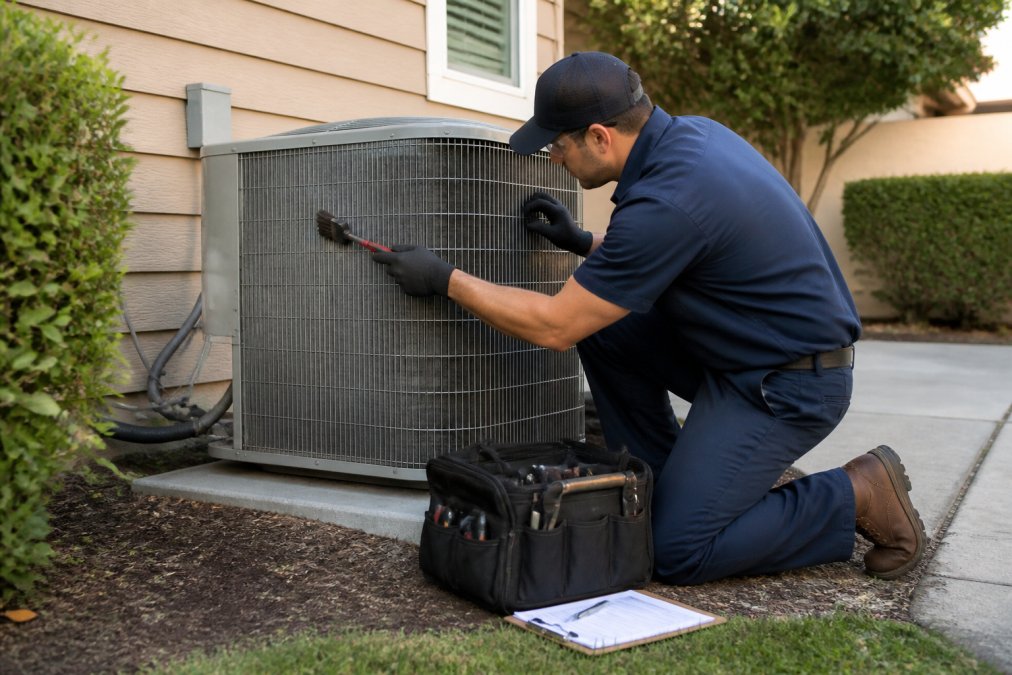
- Dirty condenser coil. The outdoor coil rejects heat. When it is coated with dust, pollen, and lawn clippings, refrigerant pressures rise, the compressor works harder, and power draw climbs for the same cooling output.
- Restricted evaporator airflow. A clogged filter or dirty indoor coil lowers airflow across the evaporator, which drops the coil temperature, invites frost, and reduces capacity.
- Low refrigerant charge. A slow leak reduces the amount of refrigerant available to absorb heat. The system runs longer to hit setpoint, and the compressor sees higher temperatures.
- Duct leakage and imbalance. Even a perfectly tuned unit loses effective capacity if a meaningful share of conditioned air escapes into the attic or crawlspace before reaching the rooms.
Each of these individually shaves efficiency. Together, they can pull a system well below its rated SEER2, a well-maintained 16 SEER2 unit can outperform a neglected 18 SEER2 unit.
A Maintenance Cadence That Protects the Rating
- Monthly: inspect and replace the filter. During heavy cooling season, check it every 30 days; a 1-inch pleated filter is cheap insurance.
- Quarterly: clear debris from around the outdoor unit and rinse the condenser coil fins (power off first).
- Annually, before cooling season: schedule a professional tune-up that includes coil cleaning, refrigerant charge verification by superheat/subcooling, capacitor and contactor inspection, condensate drain clearing, and a static pressure check.
- Every few years: have ducts inspected for leaks and re-sealed if needed.
Why This Matters for Your Payback Math
The payback calculation in the previous section assumes the new system performs near its rating. Skip maintenance and that assumption fails, the savings you counted on shrink year over year. A modest annual tune-up cost is usually far smaller than the efficiency it preserves, which is why maintenance is often treated as part of the upgrade decision, not an afterthought.
Never let a technician "top off" refrigerant without finding the leak. A system that needs repeated charging has a breach somewhere, and skipping the repair means paying for the same refrigerant again next season.
Frequently Asked Questions
What is a good SEER rating for an air conditioner?
A SEER rating of 14.3 or higher meets the current federal minimum for most new split-system ACs in the southern half of the country, while northern states require 13.4. Anything above 16 SEER2 is considered high-efficiency. If your utility bills are high or you run the AC from May through October, aiming for 16 to 18 SEER2 usually delivers the best balance of upfront cost and long-term savings. Units rated 20 SEER2 and above cost more but cut energy use significantly in hot climates.
Is a 15.2 SEER2 rating better than a 16 SEER rating?
Not directly comparable. SEER2 uses a different testing procedure with higher external static pressure, so SEER2 numbers run about 4.5% lower than the old SEER numbers for the same equipment. A 15.2 SEER2 unit is roughly equivalent to a 16 SEER unit in real performance. When comparing quotes, always check which rating standard the contractor is citing. Mixing SEER and SEER2 numbers leads to apples-to-oranges comparisons and can make a unit look better or worse than it actually is.
What is the difference between SEER and SEER2?
SEER measures cooling output divided by electric energy input over a simulated cooling season. SEER2 uses the same basic formula but tests equipment under higher external static pressure, which better reflects real-world ductwork resistance in most homes. Because of the tougher test conditions, SEER2 ratings are about 4.5% lower than SEER ratings for identical equipment. As of 2023, the Department of Energy requires SEER2 ratings for all new residential central air conditioners and heat pumps sold in the United States.
How does a higher SEER rating impact my monthly energy bills?
A higher SEER rating means the unit uses fewer kilowatt-hours to produce the same cooling output. For example, upgrading from a 10 SEER system to a 16 SEER2 system can cut cooling energy consumption by roughly 40%, depending on climate and usage. If your current cooling costs run $150 per month during summer, that reduction could save $60 per month. Actual savings depend on your local electric rates, thermostat settings, duct condition, and how well your home is insulated.
Do I need a higher SEER rating if I live in a warmer climate?
Yes. In hotter regions, your AC runs more hours per year, so every point of efficiency translates into more dollars saved. The DOE sets higher minimum SEER2 requirements for the southern half of the country (14.3 SEER2 for split systems) compared to northern states (13.4 SEER2). If you live in an area with long, brutal summers, choosing a unit rated 16 SEER2 or higher usually pays for itself faster than it would in a milder climate.
How do I find the SEER rating on my current air conditioning unit?
Check the outdoor condenser unit's data plate, usually a metal tag on the side or back of the cabinet. It lists the model number, serial number, and often the efficiency rating. If the plate is faded or missing, write down the model number and search it online, or ask a licensed HVAC technician to look it up. Units manufactured before 2006 may not list SEER at all, but most were rated between 8 and 12 SEER.
What was the typical SEER rating for air conditioners 20 years ago?
In the early 2000s, the federal minimum was 10 SEER, and many builders installed units right at that threshold. Some older systems from the 1990s were rated as low as 8 or 9 SEER. Compared to today's minimum of 14.3 SEER2 in southern states, a 20-year-old unit uses roughly 30% to 40% more electricity for the same cooling output. That gap is why replacing an aging system often lowers summer utility bills noticeably.
Should I get a 14 or 16 SEER AC?
It depends on how long you plan to stay in the home and how much you run the AC. A 14.3 SEER2 unit meets code and costs less upfront. A 16 SEER2 unit costs more but uses about 10% to 12% less energy. If you run your AC six or more months per year, the 16 SEER2 model usually pays back the price difference within five to seven years through lower electric bills. If you plan to move soon, the minimum-rated unit may be the smarter financial choice.
Efficiency ratings only pay off when the equipment is installed and maintained correctly. Air CareSaver handles both, with accurate diagnostics, energy-efficient installations, and preventative maintenance plans that protect your investment year after year. Get started with Air CareSaver and get a free estimate on your next upgrade or tune-up.