 ultimate-guide
What Is the Average Lifespan of a Residential Furnace?
Table of Contents
- How Long Does a Residential Furnace Actually Last?
- Signs of a Failing Furnace You Should Not Ignore
- When to Replace vs Repair Your Furnace
- What Affects How Long Your Furnace Lasts
- Average Furnace Replacement Cost and What It Includes
- How to Extend the Life of Your Furnace
- Warranty and Disposal: What Homeowners Often Overlook
- Conclusion: Making the Right Call for Your Home
- Frequently Asked Questions
Last Updated: October 2, 2026
How Long Does a Residential Furnace Actually Last?
The average lifespan of a residential furnace is 15 to 20 years, though that range shifts depending on fuel type, installation quality, and how consistently the system is maintained. The furnaces that reach 20 years are almost never the ones that got the least attention.
The residential furnace is the single most expensive mechanical component in most homes, and its service life is not fixed. It's negotiable. A gas furnace installed correctly and tuned annually can outlast a cheaper unit by five years or more.
Average Lifespan by Fuel Type
Fuel type sets the baseline. Gas furnaces typically run 15 to 20 years, with well-maintained units occasionally reaching 25. Electric furnaces often last 20 to 30 years because they have fewer combustion components to wear out. Oil furnaces generally fall in the 15 to 20 year range but tend to require more frequent service because of burner and nozzle fouling.
| Furnace Type | Typical Lifespan | Key Wear Factor |
|---|---|---|
| Gas | 15-20 years | Heat exchanger, ignition system |
| Electric | 20-30 years | Blower motor, heating elements |
| Oil | 15-20 years | Burner assembly, nozzle fouling |
What the 15-20 Year Range Really Means
That range is a midpoint, not a guarantee. It assumes annual maintenance, a correctly sized system, and reasonable use. A furnace that was oversized at installation will short-cycle, and short-cycling is one of the fastest ways to burn through a system's service life. A furnace that was undersized runs constantly and wears out its blower motor early.
The number most homeowners should track isn't age. It's operational efficiency. A 12-year-old furnace that's losing efficiency is closer to the end than a 15-year-old furnace that's still holding its AFUE rating.
Signs of a Failing Furnace You Should Not Ignore
The clearest signs of a failing furnace are rising energy bills, uneven heating, unusual noises, yellow rather than blue burner flames, and frequent cycling.
Homeowners often wait until the system stops working entirely. That's the expensive path. A furnace rarely fails without warning; it gives signals for months first.
Warning Signs That Signal Replacement
- Yellow or flickering flame instead of a steady blue one, which can indicate incomplete combustion
- Carbon monoxide detection or a CO alarm triggered near the furnace
- Rumbling, banging, or squealing from the blower motor or heat exchanger
- Cold spots that persist even when the thermostat is set higher
- Short-cycling, where the system turns on and off every few minutes
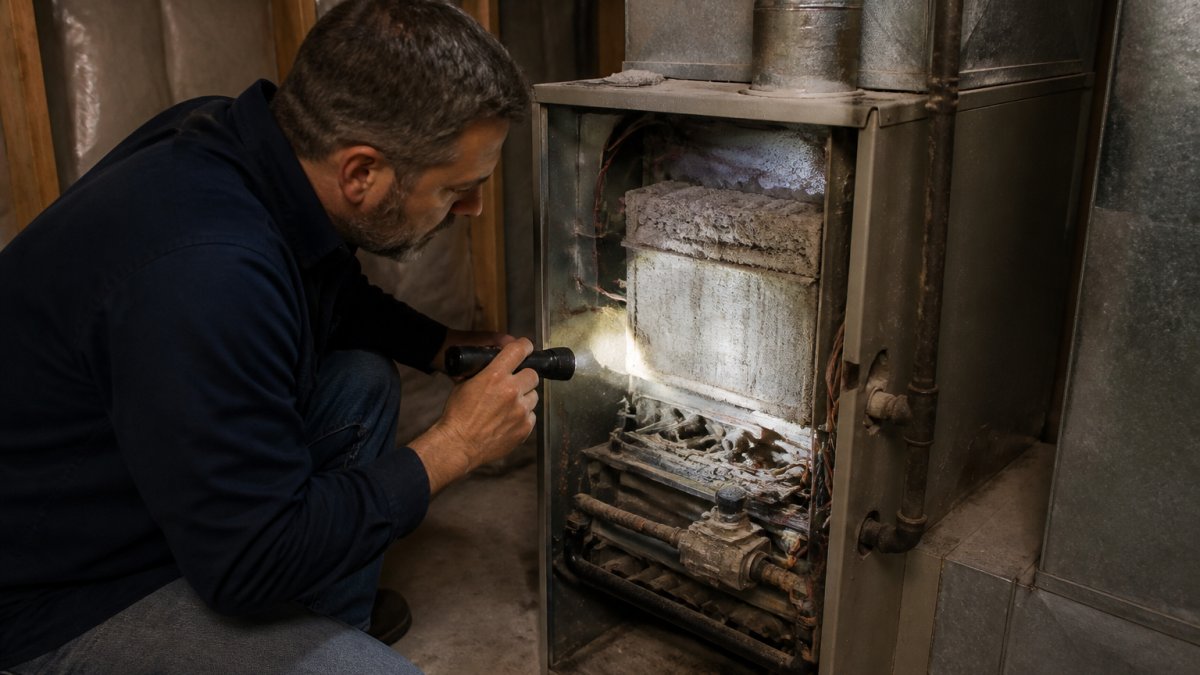
- Rust, cracks, or soot visible on the combustion chamber or heat exchanger
A cracked heat exchanger is the one sign that usually ends the conversation. It can allow carbon monoxide into the living space, and repair is rarely cost-effective.
When to Replace vs Repair Your Furnace
The decision to replace rather than repair a residential furnace usually comes down to age, repair cost relative to replacement, and whether the repair addresses a safety issue. If the system is over 15 years old and the repair costs more than a third of a new installation, replacement is typically the better call.
The 50% Rule and Other Decision Frameworks
The 50% rule is a common guideline: if a repair costs more than 50% of the price of a new furnace, replace instead. For older systems, many technicians use a stricter 30% threshold because the remaining service life is shorter.
A practical framework:
- Under 10 years old, single repair: Repair it.
- 10-15 years old, repair under 30% of replacement: Repair, but start planning.
- 15+ years old, any major repair: Replace.
- Any age, cracked heat exchanger or CO risk: Replace immediately.
What Affects How Long Your Furnace Lasts
Four factors dominate furnace longevity: maintenance frequency, climate, installation quality, and system sizing. Of these, installation quality is the one homeowners have the least control over, and it matters most. But the two factors most guides skip, regional climate load and modern thermostat behavior, are the ones you can actually change this season.
Maintenance, Climate, and Installation Quality
An annual tune-up keeps the heat exchanger clean, the blower motor lubricated, and the burner calibrated. Skipping it accelerates wear on every component.
Climate load is the factor homeowners underestimate most. A furnace doesn't age by calendar year, it ages by heating degree days.
Ductwork matters too. Leaky or undersized ducts force the blower motor to work harder, and that stress shows up as earlier failure.
How Smart Thermostats Change the Math
A smart thermostat can meaningfully extend furnace life, but only if it's configured correctly. The mechanism is short-cycling reduction. A furnace that cycles on and off every few minutes wears its ignition system, inducer motor, and heat exchanger far faster than one that runs in longer, steadier cycles. Modern controls reduce short-cycling in three ways:
- Wider deadband and cycle-rate limiting. Smart thermostats can be set to allow a wider temperature swing before calling for heat, which produces longer, more efficient cycles instead of rapid on-off behavior.
- Adaptive recovery. Instead of a hard setback that forces the furnace to blast at full capacity to recover, adaptive recovery ramps the system up gradually, fewer high-stress recovery cycles per day.
- Runtime and filter alerts. Many units track blower runtime and remind you when the filter is loaded, which protects airflow and reduces static pressure on the blower motor.
What a smart thermostat cannot do is fix a system that was installed wrong. If the furnace is oversized or the ductwork is undersized, no control setting will undo the short-cycling, it will only mask it. Use the thermostat's runtime data as a diagnostic: if your system is cycling more than three to five times per hour in mild weather, the problem is sizing or airflow, not the thermostat.
Average Furnace Replacement Cost and What It Includes
Furnace replacement cost varies widely based on system size, fuel type, efficiency rating, and whether ductwork modifications are needed. Because pricing depends on your specific home and system, the most accurate figure comes from an on-site estimate rather than a national average.
A standard replacement typically includes:
- Removal and disposal of the old unit
- New furnace and installation materials
- Labor and system commissioning
- Permit fees where required
- A post-installation safety check
Air CareSaver provides free estimates so homeowners can see the actual numbers for their home before committing. That removes the guesswork that leads to surprise costs.
How to Extend the Life of Your Furnace
Reaching the upper end of the 15-20 year range is mostly about discipline. Change the air filter every one to three months depending on household dust and pets. Schedule an annual tune-up before the heating season. Keep vents and returns unblocked. Address small noises early, because a $200 blower motor repair today prevents a $2,000 failure in February.
Preventative maintenance is the single highest-return habit for furnace longevity. It's also the one most homeowners skip until something breaks.
Warranty and Disposal: What Homeowners Often Overlook
Warranty coverage and proper disposal are two areas where homeowners routinely lose money or create problems. Most furnace warranties are prorated, meaning the parts coverage shrinks as the unit ages. Labor is often covered only for a limited period, sometimes as short as one year.
Disposal matters more than most people realize. Older furnaces contain refrigerant components, oils, and metals that require proper handling. Improper disposal can violate local environmental regulations and, in some cases, leave the previous homeowner liable. A licensed installer handles this as part of the replacement.
Conclusion: Making the Right Call for Your Home
The average lifespan of a residential furnace is a range, not a deadline, and the difference between a 15-year system and a 22-year system usually comes down to maintenance and installation quality. If your furnace is showing warning signs or approaching the end of its expected service life, an accurate diagnosis beats guesswork every time. Air CareSaver brings 21+ years of licensed experience, same-day response, and free estimates to every call, so you get honest answers about whether to repair or replace.
Frequently Asked Questions
Should a 40-year-old furnace be replaced?
A 40-year-old furnace is well past the average lifespan of 15-20 years for most residential furnaces. At that age, efficiency drops significantly, parts become harder to find, and the risk of carbon monoxide leaks from a cracked heat exchanger increases. Even if it still runs, replacement is usually the safer and more cost-effective choice.
What are the signs of a dying furnace?
Common signs include unusual noises like banging or rattling, frequent short-cycling, uneven heating between rooms, yellow instead of blue pilot light, increased energy bills, and visible rust or cracks on the heat exchanger. If you notice any of these, schedule an HVAC technician inspection before the system fails completely.
Does regular maintenance extend the life of a furnace?
Yes. Annual tune-ups that include air filter replacement, blower motor lubrication, and combustion chamber inspection help your furnace reach the upper end of its lifespan range. Skipping maintenance allows dust, wear, and small issues to compound, often cutting service life short by several years.
How much does it cost to replace a furnace for a 2000 sq ft house?
Furnace replacement cost varies based on system capacity, fuel type, ductwork condition, and installation complexity. For a 2000 sq ft home, expect pricing to depend on whether you need a standard efficiency or high-AFUE unit and whether existing ductwork needs modification. Contact Air CareSaver for a free estimate specific to your home.