 how-to
Affordable AC Repair San Gabriel: 7-Step Guide
Table of Contents
- Why San Gabriel Homeowners Overpay for AC Repair
- Step 1: Run a DIY Troubleshooting Checklist Before You Call
- Step 2: Know the Average Cost of AC Repair in Your Area
- Step 3: Verify Licensed HVAC Contractor Requirements
- Step 4: Get a Transparent Quote for Your AC Repair San Gabriel Home
- Step 5: Ask About Energy Rebates Before Approving Repairs
- Step 6: Know When Emergency HVAC Repair San Gabriel Is Worth It
- Step 7: Follow an HVAC Maintenance Checklist to Prevent Future Calls
- Frequently Asked Questions
Last Updated: September 4, 2026
Most homeowners don't realize that the price they pay for AC repair isn't just about parts and labor. It's about how the repair company structures its entire visit. Affordable AC repair San Gabriel homeowners can secure depends less on finding the cheapest ad and more on understanding how pricing, diagnostics, and contractor verification actually work.
At Air CareSaver, a family-owned HVAC business serving the San Gabriel Valley for over 21 years, we've seen the same pattern repeat: a homeowner calls for a "simple fix," gets quoted a full system replacement, and pays hundreds more than necessary. That's why we built this 7-step guide. Below, we'll show you exactly how to avoid overpaying, what a fair quote looks like, and the specific questions to ask before any technician touches your condenser unit.
Why San Gabriel Homeowners Overpay for AC Repair
The biggest reason homeowners overpay is a lack of transparency in the service call structure. Most HVAC companies charge a diagnostic fee, then apply that fee toward the repair only if you approve the work. If you decline, you lose the fee and still have a broken system.
A second driver of inflated costs is unnecessary upsells. Some contractors use the diagnostic visit as a sales pitch for a new system, even when a simple refrigerant leak or capacitor replacement would restore cooling capacity. The result is that homeowners pay for parts and labor they never needed.
The fix is straightforward: treat the repair process like any other significant purchase. Get a written quote, verify the contractor's license, and ask what the diagnostic fee covers before approving any work.
Step 1: Run a DIY Troubleshooting Checklist Before You Call
A service call typically costs a flat fee just for a technician to arrive. Before you spend that money, run through a quick checklist that resolves many common issues in minutes.
Simple Checks That Take 5 Minutes
Start with the thermostat. Confirm it's set to "cool" and the temperature is lower than the current room reading. Many "broken" systems are simply misconfigured.
Next, check the air filter. A clogged filter restricts air flow, causing the evaporator coil to freeze and the system to shut down. Replace it if it looks dirty.
Finally, inspect your circuit breaker and the outdoor condenser unit. Look for a tripped breaker or debris blocking the unit's airflow. These checks take five minutes and can save you the cost of a service call for a problem you can fix yourself.
Step 2: Know the Average Cost of AC Repair in Your Area
Most guides stop at "it depends." This one won't. While every repair is unique, understanding the typical price bands for common failures in the San Gabriel Valley will arm you against inflated quotes. The two biggest cost drivers are the diagnostic fee (the charge to send a technician to your door) and the repair itself (parts plus labor).
What a Fair Diagnostic Fee Looks Like
Pricing depends on the company and the specific service. A reputable company will apply a diagnostic fee toward the repair cost if you approve the work. If a company quotes a diagnostic fee or refuses to waive it upon approval of the repair, that's a red flag.
Typical Repair Cost Ranges (Parts + Labor)
Here are the common repair scenarios and the realistic price ranges you should expect to see on a written quote. These are not fixed prices, but they represent the competitive market rates for the area.
| Repair Type | Typical Cost Range | What It Includes |
|---|---|---|
| Capacitor Replacement | Pricing depends on quantity, dates, and delivery | The part (often $20-$50) plus 1-2 hours of labor. This is the most common and least expensive repair. |
| Contactor Replacement | Pricing depends on quantity, dates, and delivery | Similar to a capacitor; a simple electrical switch replacement. |
| Refrigerant Leak Repair (Minor) | Pricing depends on quantity, dates, and delivery | Includes locating the leak, repairing a small puncture or valve, and recharging the system with R-410A refrigerant. |
| Refrigerant Leak Repair (Major) | Pricing depends on quantity, dates, and delivery | Involves repairing or replacing the evaporator coil or condenser coil, which requires more labor and materials. |
| Thermostat Replacement | Pricing depends on quantity, dates, and delivery | Includes the cost of a new smart or programmable thermostat and installation. |
| Blower Motor Replacement | Pricing depends on quantity, dates, and delivery | The motor itself is a significant part, and labor involves accessing the air handler. |
| Compressor Replacement | Pricing depends on quantity, dates, and delivery | This is the heart of the system. A compressor failure often signals the end of the system's life, making replacement a more cost-effective option. |
Why Labor Rates Vary
Labor rates in the San Gabriel Valley vary. The variance depends on the company's overhead, the complexity of the repair, and whether the work is performed during standard business hours or as an emergency call. Always ask for a flat-rate quote for the entire repair rather than an hourly rate. A flat rate protects you from unexpected time overruns.
The 'Low-Ball' Trap
Be wary of quotes that come in significantly below typical ranges. A $99 repair quote for a compressor failure is a bait-and-switch tactic. The technician will arrive, diagnose a different (more expensive) problem, or add on 'necessary' services to inflate the final bill. A fair, transparent quote will be within the ranges above and will itemize every cost.
Step 3: Verify Licensed HVAC Contractor Requirements
California law requires HVAC contractors to hold a valid license from the Contractors State License Board (CSLB). Hiring an unlicensed operator can void your warranty and leave you liable for any damage they cause.
To verify a license, ask for the contractor's CSLB number and check it against the board's public database. Confirm the license is active and covers the type of work you need. A licensed contractor is also required to carry workers' compensation and liability insurance, which protects you if an injury occurs on your property.
Working with a licensed technician is the single most effective way to avoid shoddy workmanship and ensure your repair meets local building codes. For more on what to look for, the California CSLB consumer guide on hiring contractors offers a clear checklist of verification steps.
Step 4: Get a Transparent Quote for Your AC Repair San Gabriel Home
A transparent quote lists every line item: the diagnostic fee, each part with its price, the labor hours, and any permit costs. It does not include vague line items like "miscellaneous" or "system adjustments."
When you request a quote, ask for it in writing before any work begins. A verbal estimate leaves room for surprise charges on the final invoice. A written quote also gives you a document to reference if a dispute arises.
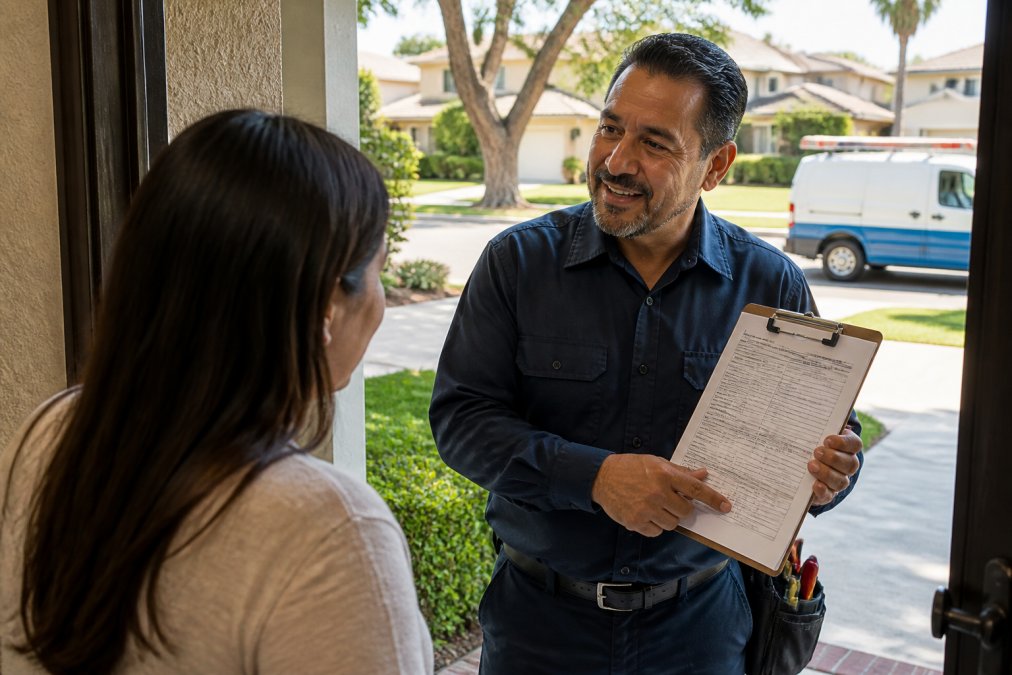
Air CareSaver provides free estimates and documents every recommended repair in writing before starting. Our technicians explain what's broken, why it needs fixing, and what the repair will cost, so you never approve work based on guesswork.
Step 5: Ask About Energy Rebates Before Approving Repairs
If your system is more than 10-15 years old and needs a major repair (like a compressor or coil), you might be at a financial crossroads. The repair could cost thousands, but a new, high-efficiency system could cost less than you think once you factor in utility rebates and long-term energy savings. This is the moment to ask your contractor about rebate programs before you authorize any work.
The Biggest Local Incentive: SoCalGas & SCE Programs
In the San Gabriel Valley, your primary utility providers are Southern California Edison (SCE) for electricity and SoCalGas for natural gas. Both offer substantial rebate programs for high-efficiency HVAC equipment.
- SCE's HVAC Rebate Program: SCE offers rebates for installing qualifying high-efficiency central air conditioners and heat pumps. Rebates for a standard central AC can range depending on the SEER (Seasonal Energy Efficiency Ratio) rating. For a heat pump, which provides both cooling and heating, rebates can be even higher.
- SoCalGas Rebates: If you have a gas furnace, SoCalGas offers rebates for installing high-efficiency furnaces (90%+ AFUE). These rebates typically range.
The 'Golden Rule' for Rebates
Here's the catch: Rebates are almost always paid after the installation is complete, not as an instant discount. You pay the contractor upfront, then submit the paperwork to the utility to receive your rebate check. This is a critical distinction. A contractor who promises to 'deduct the rebate' from your upfront price is often inflating the base price to cover the difference.
How to Check Your Eligibility
- Get the Model Number: Before you approve a repair or replacement, ask your contractor for the specific model number of the proposed equipment.
- Check the Database: Use the DSIRE database for California rebates or visit the SCE and SoCalGas websites directly. Search for the model number to confirm it qualifies for a rebate.
- Ask for the Rebate Form: A knowledgeable contractor will provide you with the rebate form and explain the submission process. If they can't, that's a sign they are not familiar with local incentive programs.
The 'Replacement vs. Repair' Calculation
Let's say your 14-year-old system needs a new compressor. A new, high-efficiency 16 SEER system might cost more. The difference is significant. If you qualify for a rebate and save an estimated amount per year on cooling costs, the payback period can be calculated. In this case, the repair is the more affordable choice. However, if the compressor is under warranty and the repair is less, the math changes dramatically in favor of the repair.
Step 6: Know When Emergency HVAC Repair San Gabriel Is Worth It
An emergency HVAC repair is worth the premium when your system failure creates a safety hazard or threatens your property. A refrigerant leak, electrical issue, or complete system failure during a heat wave qualifies. A noisy but functioning system does not.
For non-emergency issues, schedule a standard appointment and avoid the after-hours premium. For genuine emergencies, look for a company that offers same-day response and clearly communicates its emergency dispatch process.
Air CareSaver offers same-day response for urgent cooling failures, so a broken system during business hours doesn't mean days of downtime for your home or office.
Step 7: Follow an HVAC Maintenance Checklist to Prevent Future Calls
Preventative maintenance is the most affordable AC repair San Gabriel homeowners will never need to make. A seasonal tune-up catches small issues before they become expensive failures.
| Maintenance Task | Frequency | What It Prevents |
|---|---|---|
| Replace air filter | Every 1-3 months | Restricted airflow, frozen coils |
| Clean condenser coils | Annually | Overheating, reduced cooling capacity |
| Check refrigerant levels | Annually | Compressor failure, poor performance |
| Inspect electrical connections | Annually | Safety hazards, system shutdown |
| Calibrate thermostat | Annually | Short cycling, wasted energy |
A licensed technician performing this checklist will also inspect the ductwork for leaks, verify proper air flow, and test system performance. According to the U.S. Department of Energy's guide to maintaining your air conditioner, regular maintenance keeps your system running efficiently and extends its lifespan.
Skipping maintenance is a false economy. The cost of a tune-up is a fraction of the price of a compressor replacement or an emergency repair.
Finding affordable AC repair San Gabriel homeowners can trust isn't about luck. It's about running a quick DIY check, understanding how quotes are structured, verifying your contractor's license, and asking about rebates before approving work. Air CareSaver has provided licensed, family-owned HVAC service for over 21 years, backed by a 4.9 Google rating and 270+ reviews. Our technicians provide accurate diagnostics, free estimates, and same-day response, so you get honest repairs without unnecessary parts or guesswork. Get My Free Quote and let our team restore your comfort with reliable, transparent service.
Frequently Asked Questions
What is the average cost of an AC service call in the San Gabriel Valley?
Service call fees in the San Gabriel Valley typically cover the technician's trip and initial diagnostic. Pricing varies by company and time of day, so it's wise to ask for the fee upfront. Some companies waive the diagnostic charge if you approve the repair. Air CareSaver offers free estimates, so you know the full picture before any work begins. Always confirm whether the quoted fee applies to the repair cost if you move forward.
What is the $5,000 rule for AC repair vs. replacement?
A common industry guideline suggests that if your repair estimate exceeds a significant amount, or the cost is more than half the value of a new, energy-efficient system, replacement is often the smarter financial choice. This is especially true for systems over 10-15 years old. A licensed technician can provide a transparent quote for the repair and explain the expected lifespan and efficiency gains of a new system to help you decide.
How can I tell if my AC needs a simple repair or a full system replacement?
Consider the system's age, repair history, and efficiency. If your unit is under 10 years old and this is the first major issue, a repair is usually worthwhile. Frequent breakdowns, rising energy bills, or the need for refrigerant (R-22) in an older unit often point toward replacement. An accurate diagnostic from a licensed technician will identify the root cause and give you the facts to make an informed choice.
What should I look for when hiring a licensed HVAC contractor?
Verify the contractor holds a valid California license and carries workers' compensation insurance. Look for a proven track record, like 21+ years in business and strong local reviews. Ask if they offer same-day response and free estimates. A reputable contractor will provide a detailed written quote and won't pressure you into unnecessary upgrades or parts.
This article was written using GrandRanker
Frequently Asked Questions
Q: What is the average cost of an AC service call in the San Gabriel Valley?
A: Service call fees in the San Gabriel Valley typically cover the technician's trip and initial diagnostic. Pricing varies by company and time of day, so it's wise to ask for the fee upfront. Some companies waive the diagnostic charge if you approve the repair. Air CareSaver offers free estimates, so you know the full picture before any work begins. Always confirm whether the quoted fee applies to the repair cost if you move forward.
Q: What is the $5,000 rule for AC repair vs. replacement?
A: A common industry guideline suggests that if your repair estimate exceeds a significant amount, or the cost is more than half the value of a new, energy-efficient system, replacement is often the smarter financial choice. This is especially true for systems over 10-15 years old. A licensed technician can provide a transparent quote for the repair and explain the expected lifespan and efficiency gains of a new system to help you decide.
Q: How can I tell if my AC needs a simple repair or a full system replacement?
A: Consider the system's age, repair history, and efficiency. If your unit is under 10 years old and this is the first major issue, a repair is usually worthwhile. Frequent breakdowns, rising energy bills, or the need for refrigerant (R-22) in an older unit often point toward replacement. An accurate diagnostic from a licensed technician will identify the root cause and give you the facts to make an informed choice.
Q: What should I look for when hiring a licensed HVAC contractor?
A: Verify the contractor holds a valid California license and carries workers' compensation insurance. Look for a proven track record, like 21+ years in business and strong local reviews. Ask if they offer same-day response and free estimates. A reputable contractor will provide a detailed written quote and won't pressure you into unnecessary upgrades or parts.