 listicle
7 Signs Your AC Refrigerant Is Leaking
Table of Contents
- What an AC Refrigerant Leak Actually Does to Your System
- 7 Warning Signs Your AC Refrigerant Is Leaking
- How to Find Refrigerant Leaks in an AC System
- Dangers of Refrigerant Leaks in Your Home
- Cost to Repair an AC Refrigerant Leak: What Affects the Price
- EPA Regulations, Refrigerant Types, and Why R-22 Systems Face Extra Costs
- Preventative Maintenance That Catches Leaks Early
- Frequently Asked Questions
Last Updated: September 11, 2026
What an AC Refrigerant Leak Actually Does to Your System
An AC refrigerant leak is a loss of the chemical coolant that absorbs heat from your indoor air and releases it outside. Refrigerant is not consumed during normal operation; it circulates in a sealed loop. If the charge drops, cooling capacity drops with it, and the compressor works harder to compensate. At Air CareSaver, we treat a low charge as a symptom, not a diagnosis: the real question is always where the refrigerant escaped and whether the leak is small enough to seal. The U.S. Environmental Protection Agency's refrigerant management guidance explains why this matters beyond comfort, since refrigerant releases are regulated under federal clean air rules.
7 Warning Signs Your AC Refrigerant Is Leaking
The most reliable way to catch a leak early is to watch for a cluster of symptoms, not one. A single sign rarely confirms a leak, but two or three together usually do. Here are the seven warning signs we see most often.
- Hissing or bubbling sounds near the indoor unit or line set
- Ice buildup on the evaporator coil or refrigerant lines
- Warm air from the vents despite the thermostat calling for cooling
- Short cycling, where the system turns on and off rapidly
- Higher energy bills with no change in usage habits
- Compressor strain, including loud humming or hard starts
- Musty odors and moisture accumulation near the air handler
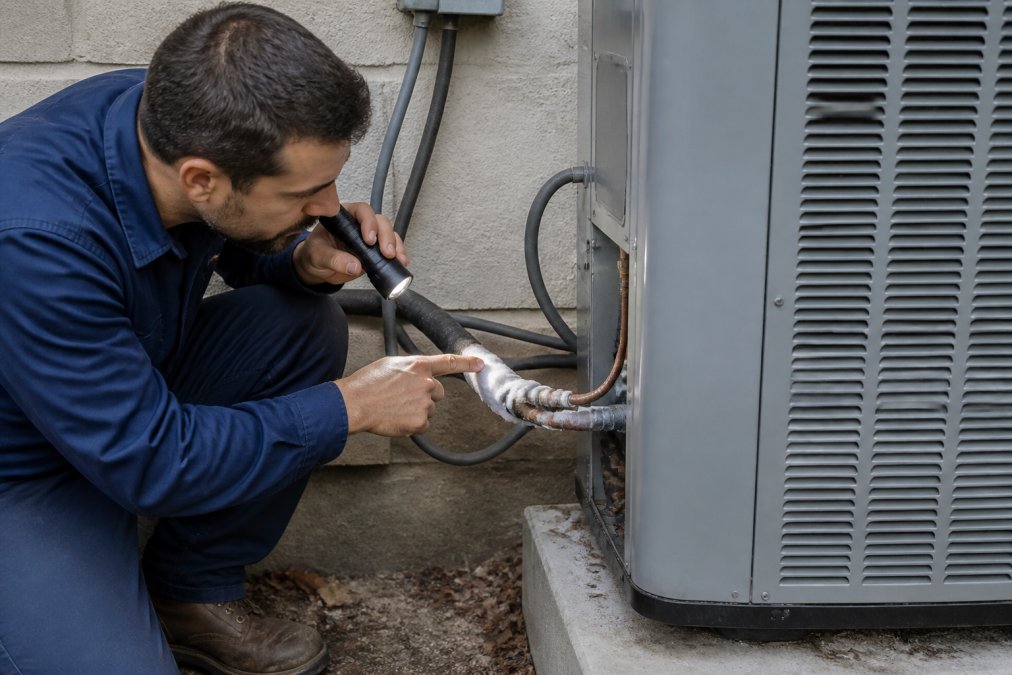
Hissing or Bubbling Sounds Near the Indoor Unit
A hissing sound usually points to a pressurized leak on a high-pressure line or a failing thermal expansion valve. Bubbling often means air or moisture has entered the system, which happens when the charge is low enough to pull a vacuum in part of the loop. A pinhole leak on a copper line can stay silent for months, then become audible once the gap widens.
Ice Buildup on Evaporator Coils and Refrigerant Lines
Ice on the evaporator coil or the larger insulated line is a classic low-charge symptom. When refrigerant pressure drops, the coil temperature falls below freezing and condensation turns to ice, which insulates the coil and blocks airflow. If you see frost, turn the system off rather than chipping at it; running a frozen system risks compressor damage.
Warm Air, Weak Cooling, and Short Cycling
Warm air from the registers plus short cycling is the combination that most often sends homeowners searching for signs your AC refrigerant is leaking. The system cools for a few minutes, fails to hit the setpoint, and shuts down on a safety limit. Short cycling almost always traces back to a pressure or airflow problem, and refrigerant loss is a leading cause.
Higher Energy Bills and Compressor Strain
A system low on refrigerant runs longer to reach the same temperature, so efficiency falls even when nothing else has changed. The compressor absorbs most of that strain, compressing a lower-pressure gas, which raises internal temperatures and can shorten its service life. If your bills climbed while your cooling dropped, that pairing is a strong signal.
Musty Smells, Moisture Accumulation, and Dizziness
A musty smell near the air handler often comes from moisture accumulation when a coil ices over and thaws repeatedly. Dizziness and headaches are a separate concern: refrigerant vapor displaces oxygen in an enclosed space, and some refrigerants break down into lung-irritating compounds when they contact an open flame. If you smell something sweet or chemical and feel lightheaded, ventilate the area and leave the equipment off until a technician inspects it.
How to Find Refrigerant Leaks in an AC System
You can narrow down a leak without touching the sealed system. A visual inspection covers the parts a homeowner can safely reach and gives a technician a head start. Anything involving gauges, refrigerant handling, or opening the loop requires a licensed professional.
Step-by-Step Visual Inspection You Can Do Safely
- Turn the system off at the thermostat and the disconnect
- Look for frost or ice on the larger insulated suction line
- Check the evaporator coil access panel for water stains or ice
- Inspect visible copper lines for oil residue, which often marks a pinhole leak
- Listen for hissing near the indoor air handler with the system running
- Note any musty smell or damp insulation around the coil cabinet
- Photograph anything unusual before calling a technician
The oil-residue check is the one most homeowners miss: refrigerant carries lubricating oil through the loop, so a small leak often leaves a faint oily stain even when no frost is visible.
When to Call a Licensed HVAC Technician
Call a technician when you find oil residue, persistent frost, or a hissing sound, or when cooling fails entirely. Confirming a leak requires an electronic leak detector or ultraviolet dye injected into the system, plus pressure testing to verify the repair held. Handling refrigerant is regulated work, and the EPA's Section 608 certification requirements set the training standard for anyone who services this equipment. A technician should also check the refrigerant charge against the manufacturer's specification rather than simply topping it off.
Dangers of Refrigerant Leaks in Your Home
The dangers of refrigerant leaks fall into three buckets: health, equipment, and environment. Refrigerant vapor is heavier than air and collects in low spaces such as basements and crawlspaces. Mild exposure can cause dizziness, headache, and nausea; higher concentrations can cause frostbite on skin. A chronically low charge overheats the compressor and can end in a full system replacement. Environmentally, leaked refrigerant is a potent greenhouse gas, and federal rules restrict how it may be vented or handled.
Cost to Repair an AC Refrigerant Leak: What Affects the Price
The cost to repair an AC refrigerant leak depends on where the leak is, how accessible it is, and what refrigerant your system uses. A leak at an accessible flare fitting or service valve is straightforward; a leak inside an evaporator coil may require coil replacement rather than a patch. Refrigerant type also drives cost, since older R-22 systems use a phased-out refrigerant that is far more expensive and harder to source than R-410A.
| Leak Location | Typical Repair Approach | Cost Driver |
|---|---|---|
| Accessible line or fitting | Seal or replace fitting | Labor time |
| Evaporator coil | Patch, or coil replacement | Part cost, access |
| Condenser coil | Weld or replace | Refrigerant recovery |
| R-22 system | Recharge with phased-out refrigerant | Refrigerant availability |
Because pricing varies by system, refrigerant type, and leak severity, we provide free estimates rather than quoting a flat figure over the phone, so you see the actual scope before you commit.
Repair vs. Replace: A Decision Framework, Not a Guess
Here is the framework we actually use on service calls. Score your situation against the four questions below. Three or more answers in the right-hand column is a strong signal to replace rather than patch.
| Question | Lean Repair | Lean Replace |
|---|---|---|
| Where is the leak? | Accessible line, fitting, or service valve | Inside the evaporator or condenser coil |
| How old is the system? | Under 10 years, well maintained | Over 12-15 years, or unknown service history |
| What refrigerant does it use? | R-410A or a current low-GWP blend | R-22 (Freon) or another phased-out refrigerant |
| Has the compressor been stressed? | Normal amp draw, no hard starts | Repeated low-charge operation, hard starts, or a prior compressor repair |
Two mechanical realities drive this framework. First, a coil leak on an aging system is rarely the last one, copper thins from the inside out, so the pinhole you seal this spring is often followed by another within a season or two. Second, every low-charge hour adds heat and wear; a compressor that has survived one long low-charge event is a coin flip, and replacing a compressor on an old system usually costs more than the system is worth.
The Math Homeowners Usually Miss
A recharge without a repair is the most common mistake we see. If the system is losing charge, adding refrigerant only buys time until the next loss, and on an R-22 system, that recharge is the most expensive line item on the invoice. A sealed repair on a healthy mid-life system almost always wins on first-year cost. A second or third repair on a 15-year-old R-22 system usually loses to replacement on three-year cost once you factor in refrigerant scarcity, efficiency gains, and the odds of the next failure.
We walk through both paths with you before recommending either, and put the estimate in writing so the comparison is apples to apples.
EPA Regulations, Refrigerant Types, and Why R-22 Systems Face Extra Costs
Federal rules govern how refrigerants are handled, recovered, and disposed of, which is why leak repair is not a do-it-yourself job. The U.S. Environmental Protection Agency's refrigerant management guidance sets the handling and recovery requirements, and the EPA's Section 608 certification requirements set the training standard for anyone who services this equipment. Knowing which refrigerant is in your system tells you most of what you need to know about repair economics.
The Three Refrigerant Eras in Home Cooling
| Refrigerant | Status | What It Means for You |
|---|---|---|
| R-22 (Freon) | Phased out for new equipment; production and import ended | Recharges rely on reclaimed or stockpiled supply, so cost and availability both move against you |
| R-410A | Long-time standard replacement for R-22 | Widely available; still a high-GWP refrigerant and now itself being phased down |
| Lower-GWP blends (e.g., R-32, R-454B) | Increasingly common in new equipment | Better environmental profile; not a drop-in for older systems |
R-22 was phased out for new equipment because of its ozone-depleting potential. Systems still running on it can only be serviced with reclaimed or stockpiled supply, and that scarcity pushes recharge costs up, often to the point where the refrigerant alone rivals the cost of a minor repair. R-410A became the standard replacement, and lower-GWP blends are now common in new installations under the current phasedown schedule.
Why This Changes Your Repair Decision
If your system uses R-22, factor refrigerant availability into any repair decision. A sealed repair can still make sense if the leak is accessible and the compressor is healthy, but a recharge-only fix rarely does, you are paying premium prices for a gas that will leak out again. If your system uses R-410A, the calculus is friendlier today, but the phasedown means your next system will likely use a different refrigerant, worth knowing before a major repair on an older R-410A unit.
What Is Not Allowed
Federal clean air rules restrict how refrigerant may be vented or handled. You cannot legally vent refrigerant to the atmosphere or buy it without the proper certification. That is why a homeowner cannot "just top it off", the equipment, certification, and recovery requirements all sit with licensed technicians. If a contractor offers to add refrigerant without first finding and fixing the leak, treat that as a red flag.
If you are unsure which refrigerant your system uses, the data plate on the outdoor condenser unit lists it. Photograph the plate before you call, it lets a technician give a more accurate picture of your options on the first visit.
Preventative Maintenance That Catches Leaks Early
An annual tune-up catches small leaks before they become compressor failures. A technician checks system pressure, inspects the evaporator and condenser coils, verifies the refrigerant charge, and looks for early leak signs. The real value of maintenance is timing: catching a pinhole leak in spring costs far less than replacing a compressor in August, and scheduling before the cooling season means you are not competing for appointments during the first heat wave.
A refrigerant leak rarely announces itself. It shows up as a higher bill, a warmer room, or a sound you cannot quite place, and by the time cooling fails, the compressor may already be damaged. Air CareSaver has spent more than 21 years diagnosing exactly these problems across the San Gabriel Valley, with licensed technicians (#1054832), same-day response, and free estimates so you know the scope before any work begins. If you have spotted any of the signs above, get a free quote from Air CareSaver for an accurate diagnosis instead of a guess.
Frequently Asked Questions
Can I stay in my house with a refrigerant leak?
Short-term exposure to low refrigerant levels is usually not dangerous, but a significant AC refrigerant leak can displace oxygen in a closed room and cause dizziness, headaches, or nausea. Refrigerants like R-410A and R-22 are heavier than air and pool near the floor. If you smell something sweet or chemical near your air handler, open windows and step outside. Call a licensed HVAC technician before running the system again. People with heart conditions, asthma, or young children should treat any suspected leak as a reason to ventilate and get professional help quickly.
How long will Freon last with a leak?
It depends entirely on the size of the leak. A pinhole leak in an evaporator coil might drain a system over several months, while a cracked line can empty it in days. Refrigerant does not get consumed like fuel, so any drop in refrigerant charge means there is a leak somewhere. Topping off Freon without finding and sealing the leak just delays the problem and strains the compressor. A technician using an electronic leak detector or ultraviolet dye can pinpoint the source and give you a realistic timeline.
Where is the most common place for an AC refrigerant leak?
Evaporator coils are the most frequent source, followed by line sets running through walls or attics, and the Schrader valves on service ports. Coils develop pinhole leaks from formicary corrosion, a chemical reaction that attacks copper tubing. Vibration and thermal expansion wear down flare fittings over time. High-pressure lines and the condenser unit also develop leaks, especially in older systems. A technician checks all these points during a proper leak detection service rather than guessing at one spot.
Is it expensive to fix an AC refrigerant leak?
The cost to repair an AC refrigerant leak varies widely based on where the leak is and what refrigerant your system uses. A simple Schrader valve fix is on the low end, while replacing a leaking evaporator coil runs much higher because it involves labor and parts. Systems still using R-22 face added cost because that refrigerant is phased out under EPA regulations and now sells at a premium. Air CareSaver provides free estimates, so you know the scope before any work begins.