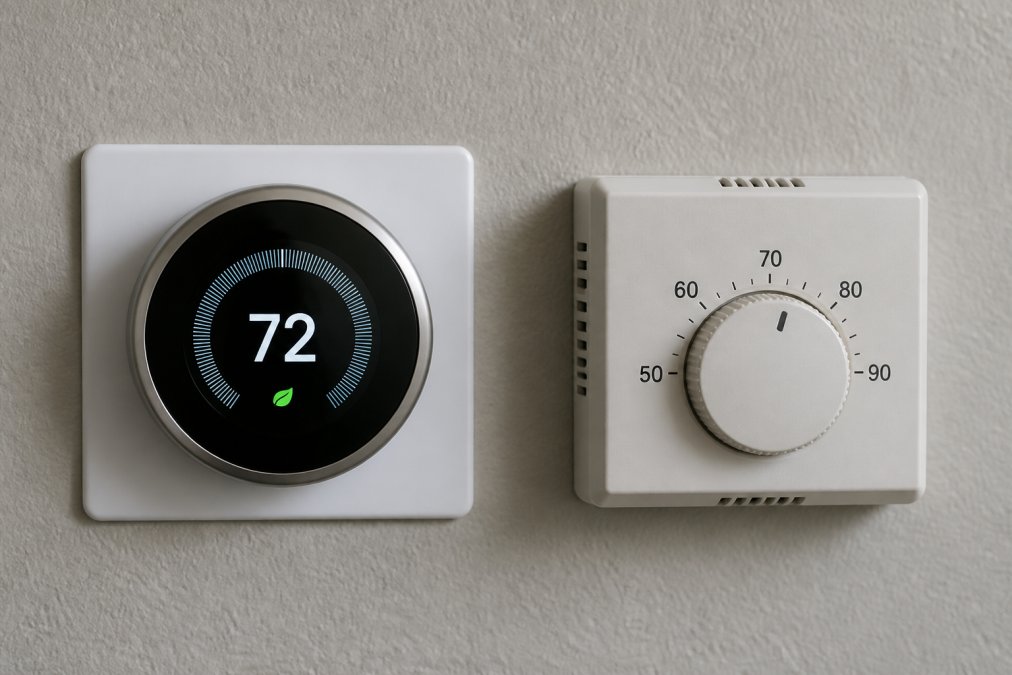
 comparison
Smart HVAC System vs Manual Thermostat Cost: 2026 Guide
Table of Contents
- Smart HVAC System vs Manual Thermostat Cost: The Bottom Line
- Upfront Cost Breakdown: Manual vs Smart Thermostats
- Smart Thermostat Installation Cost: DIY vs Professional
- C-Wire Requirements for Smart Thermostats: What It Means for Your Home
- HVAC Energy Efficiency Savings: How Much Can You Cut Your Bills?
- Total Cost of Ownership Over 5-10 Years
- Utility Rebates and Energy Star Incentives That Lower Your Cost
- Smart HVAC System Integration vs Standalone Thermostat: Which Is Worth It?
- Frequently Asked Questions
Last Updated: September 13, 2026
Smart HVAC System vs Manual Thermostat Cost: The Bottom Line
The smart HVAC system vs manual thermostat cost question comes down to this: a manual thermostat costs less upfront, but a smart thermostat often costs less to own over five to ten years. This guide from Air CareSaver breaks down the numbers so you can decide with real figures instead of marketing claims.
The gap starts at the wall. A basic manual dial thermostat typically sells for a fraction of what a smart model costs, and that price difference is the single biggest reason homeowners hesitate. But the upfront number hides the more important one: what each device costs you every month in heating and cooling bills, and what happens when the equipment it controls fails early.
Below, we'll show you exactly how to compare upfront cost, installation, wiring, energy savings, and long-term ownership so you can pick the option that actually pays off.
Upfront Cost Breakdown: Manual vs Smart Thermostats
Manual thermostats win on sticker price, and it isn't close. A basic non-programmable dial unit is one of the cheapest components in your entire HVAC system, while smart models carry the cost of sensors, Wi-Fi connectivity, and the software behind them.
Manual and Programmable Thermostat Prices
A basic manual dial thermostat is inexpensive, and a programmable model sits slightly higher because it adds scheduling. Neither requires an app, an account, or a network connection. For a homeowner who wants a simple, replaceable part, this is the lowest-cost entry point available.
Smart Thermostat Prices and Features
Smart thermostat prices vary widely by brand and feature set. Here's how the most common models compare:
| Model | Starting Price | Key Features | Best For |
|---|---|---|---|
| Amazon Smart Thermostat | $80 | Alexa control, basic scheduling | Budget buyers in the Alexa ecosystem |
| Mysa Smart Thermostat | $120 | Geofencing, energy tracking | Electric baseboard and high-voltage heat |
| Google Nest Learning Thermostat | $130 | Auto-Schedule, energy history | Hands-off automation |
| Ecobee Smart Thermostat Premium | $244 | Room sensors, air quality monitoring | Multi-room temperature balancing |
The spread matters. You can enter smart control for roughly the price of a mid-range programmable unit, or pay several times that for room-by-room sensing. What most buyers miss is that the cheapest smart model still delivers the core benefit: remote access and automated scheduling.
Smart Thermostat Installation Cost: DIY vs Professional
Installation is where the smart HVAC system vs manual thermostat cost comparison gets interesting, because the two devices don't install the same way. A manual thermostat is a two-wire swap. A smart thermostat may need a C-wire, a compatible system, and a working network connection.
DIY Installation Costs and Risks
DIY installation saves the labor charge but shifts the risk to you. A common mistake is assuming the wiring behind your old thermostat matches what the new one needs. It often doesn't. Miswiring can blow a low-voltage fuse on the control board, and on older systems it can damage the transformer.
If you're comfortable identifying wires and killing power at the breaker first, a straightforward swap is manageable. If your wiring looks like a bundle of unlabeled conductors, stop.
Professional Installation Labor and Fees
Professional installation covers the labor, the system check, and the configuration of schedules and app pairing. It also catches compatibility problems before they become a service call. At Air CareSaver, free estimates mean you know the scope before any work starts, and our licensed technicians (#1054832) verify that the thermostat matches your equipment rather than guessing.
C-Wire Requirements for Smart Thermostats: What It Means for Your Home
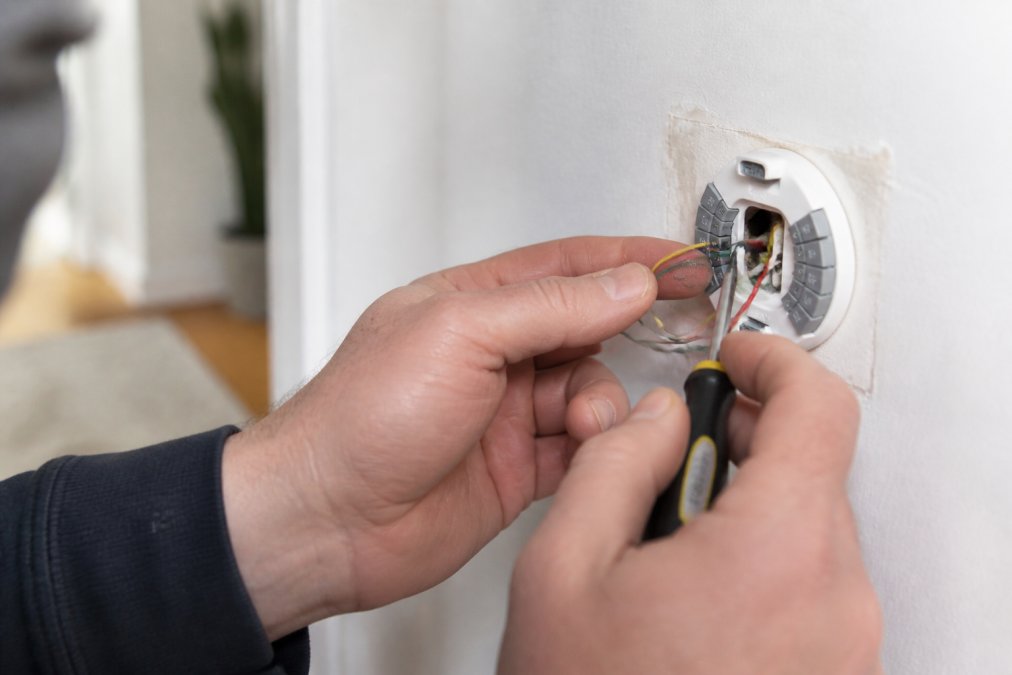
A C-wire, or common wire, is the dedicated power conductor a smart thermostat needs to run continuously without draining its battery. Without one, the device may cycle, drop off Wi-Fi, or fail to hold a schedule.
Homes With a C-Wire vs Without
Many homes built or updated in the last couple of decades already have a C-wire tucked behind the thermostat. If yours does, installation is close to a direct swap.
Older homes often don't. If you see only two or three wires, you're in the no-C-wire group, and that changes both the installation approach and the cost.
Cost to Add a C-Wire or Use an Adapter
You have two paths. An adapter kit lets the thermostat draw power without a new conductor, and it's the cheaper option when it's compatible with your equipment. Running a new C-wire is more involved because it means fishing a conductor through the wall to the air handler.
Pricing for either route depends on your home's layout and system type, so get a written estimate rather than a phone guess.
HVAC Energy Efficiency Savings: How Much Can You Cut Your Bills?
Energy savings come from scheduling and setback behavior, not from the thermostat's brand. The mechanism is straightforward: a smart thermostat reduces runtime when the house is empty and prevents the "set it and forget it" drift that manual dials invite. But the size of that savings depends on variables you can actually estimate before you buy.
The Three Variables That Drive Your Savings
The savings from a smart thermostat scale with three factors:
- How often the house is empty. A household where everyone is gone 8-10 hours on weekdays has more setback opportunity than a home with someone present all day.
- How far you set back the temperature. The Department of Energy recommends setting your thermostat back 7-10 degrees Fahrenheit for 8 hours a day from its normal setting to see meaningful savings (energy.gov). A smart thermostat applies that setback automatically; a manual dial relies on someone remembering.
- Your climate and equipment type. A heat pump responds differently to setback than a gas furnace, and savings in a mild climate are smaller than in a climate with long heating or cooling seasons.
How the Savings Actually Happen
A smart thermostat cuts runtime in two ways. First, scheduled or geofenced setbacks stop conditioning an empty house. Second, learning algorithms (like Nest's Auto-Schedule or Ecobee's eco+ mode) adjust based on occupancy patterns and, in some cases, utility peak-demand events. Room sensors extend that logic by prioritizing the rooms you actually occupy instead of averaging the whole house.
Manual thermostats can save energy too, if someone adjusts them consistently. Most households don't. That behavior gap is where the savings live, and it's why the same equipment can produce very different bills depending on who is home to touch the dial.
Estimating Your Own Payback
Rather than trust a marketing percentage, run your own math. Pull your last 12 months of utility bills and average the monthly heating and cooling portion. Apply a conservative savings range of 8-12% to that figure, which is the band most utility program evaluations and Energy Star guidance fall within for homes that adopt consistent setbacks (energystar.gov). Multiply by 12 for an annual figure, then divide your total smart thermostat cost (device plus any installation) by that annual savings number to get your break-even in years.
Example: if your annual heating and cooling spend is $1,200 and you capture 10%, that's $120 per year. A $130 thermostat installed yourself breaks even in roughly 13 months. A $244 thermostat with $150 of professional installation breaks even in about 3.3 years. The device that costs more today often costs less by year three, but only if the setback behavior actually happens.
Total Cost of Ownership Over 5-10 Years
Total cost of ownership is where the smart HVAC system vs manual thermostat cost calculation flips, but only if you build the math instead of trusting the slogan. Here is the framework most comparisons skip.
The Four Cost Buckets
Every thermostat decision carries four costs across a 5-10 year window:
- Purchase price. Manual dial: roughly $15-$40. Programmable: roughly $25-$80. Smart: roughly $80-$250 depending on sensors and features.
- Installation. Manual and programmable: typically $0 if you swap it yourself, or a small service call if you hire out. Smart: $0 DIY or a professional labor charge if you need a C-wire run or system configuration.
- Energy cost. This is the variable that moves the outcome. A manual thermostat with no automation typically delivers the least savings. A smart model with consistent setbacks can trim the heating and cooling portion of your bill, and that reduction compounds every year.
- Equipment wear. Short-cycling and constant manual adjustments put stress on your HVAC equipment. A thermostat that runs steadier cycles supports compressor and blower longevity.
A Side-by-Side 10-Year Model
Using the same $1,200 annual heating and cooling spend and a conservative 10% savings figure from the previous section:
| Cost Bucket | Manual Thermostat | Smart Thermostat (DIY) | Smart Thermostat (Pro Install) |
|---|---|---|---|
| Purchase | $30 | $130 | $244 |
| Installation | $0 | $0 | ~$150 |
| 10-yr energy (no savings) | $12,000 | , | , |
| 10-yr energy (10% savings) | , | $10,800 | $10,800 |
| 10-year total | $12,030 | $10,930 | $11,194 |
In this model, the DIY smart install saves roughly $1,100 over ten years versus the manual dial, and the professionally installed smart unit still saves roughly $836. The break-even point lands in year two for the DIY install and year three for the pro install. Change the savings rate to 5% and the pro-install break-even stretches past year five; change it to 15% and it drops under two years.
Why the Model Is Sensitive
The outcome hinges on the savings rate, not the sticker price. A $244 thermostat that captures 12% beats a $130 thermostat that captures 4%, because the annual energy delta dwarfs the $114 purchase difference within two years. This is the part of the comparison most buyers get backwards: they optimize the one-time cost and ignore the recurring one.
System longevity belongs in the math too, but it's harder to quantify. A thermostat that runs the system in steadier cycles supports HVAC performance over its service life.
Utility Rebates and Energy Star Incentives That Lower Your Cost
Utility rebates and Energy Star certification can shrink the upfront gap significantly. Many utilities offer rebate programs for qualifying smart thermostats, and Energy Star certification is often the eligibility threshold.
Start by checking your utility's current rebate list and the Energy Star thermostat program requirements before you buy. Rebate amounts and eligible models change, so confirm the specific model qualifies rather than assuming any smart thermostat does.
Keep your receipt and the model number. Most programs require proof of purchase and installation, and some require a licensed installer.
Smart HVAC System Integration vs Standalone Thermostat: Which Is Worth It?
A standalone smart thermostat controls temperature. A fully integrated smart HVAC system coordinates the thermostat, sensors, and equipment as one system, and the cost difference reflects that scope.
Standalone makes sense when your equipment is in good shape and you mainly want scheduling and remote access. Integration makes sense when you're already facing a repair or replacement, because the thermostat decision is bundled into a larger project.
This is the angle most comparisons skip. The right question isn't "smart or manual" in isolation. It's whether your HVAC system has enough remaining service life to justify a smart controller, or whether the smarter move is to put that money toward equipment that's nearing the end of its run.
That's where a diagnostic matters more than a product comparison. Air CareSaver's technicians diagnose the actual condition of your system before recommending a thermostat, so you're not upgrading a controller on equipment that needs replacement. With 21+ years of licensed experience and a 4.9 Google rating across 270+ reviews, we've seen both mistakes: homeowners who overspent on smart controls for failing systems, and homeowners who replaced working equipment they didn't need to.
Frequently Asked Questions
How much can a smart thermostat save on monthly energy bills?
Energy Star estimates smart thermostats can save an average of $50 per year on heating and cooling costs, with some users saving more depending on climate and usage. Your actual savings depend on your HVAC system's age, your local utility rates, and how consistently you use scheduling and geofencing features. A smart thermostat cost is often recovered within 2-3 years through reduced energy consumption.
Does a smart thermostat require a C-wire for installation?
Most smart thermostats need a C-wire (common wire) to provide continuous power. If your home lacks one, you have options: use a power adapter kit, run a new wire, or choose a model that works without a C-wire. Adding a C-wire professionally typically costs $100-$200 in labor. Check compatibility before buying to avoid surprises during smart thermostat installation.
Can I replace my existing manual thermostat with a smart model?
Yes, in most cases. Smart thermostats are compatible with standard 24V HVAC systems found in most homes. However, electric baseboard heaters and some older systems may need specialized models. Before purchasing, verify your system type and wiring. A licensed HVAC technician can confirm compatibility and handle installation if you're unsure about C-wire requirements.
Is there a downside to installing a smart thermostat?
Smart thermostats have few downsides, but they exist. Some older HVAC systems have compatibility issues that require extra wiring or adapters. The upfront smart thermostat cost is higher than manual models. Also, features like geofencing can cause temperature swings if not configured properly. Professional installation reduces these risks and ensures your system works efficiently.
What is the $5000 rule for HVAC?
The $5000 rule is a general guideline suggesting that if a repair costs more than $5,000, you should consider replacing the system instead. This threshold helps homeowners decide when repairing an aging unit no longer makes financial sense. However, the decision should also factor in system age, efficiency ratings, and long-term energy efficiency savings from a new installation.
The hardest part of this decision isn't the price tag on the thermostat. It's knowing whether your existing HVAC system is worth upgrading around. Air CareSaver handles that diagnosis with free estimates, same-day response, and accurate diagnostics that tell you what your system actually needs instead of what's easiest to sell. Get started with Air CareSaver and get a clear answer on your thermostat and HVAC upgrade before you spend a dollar.