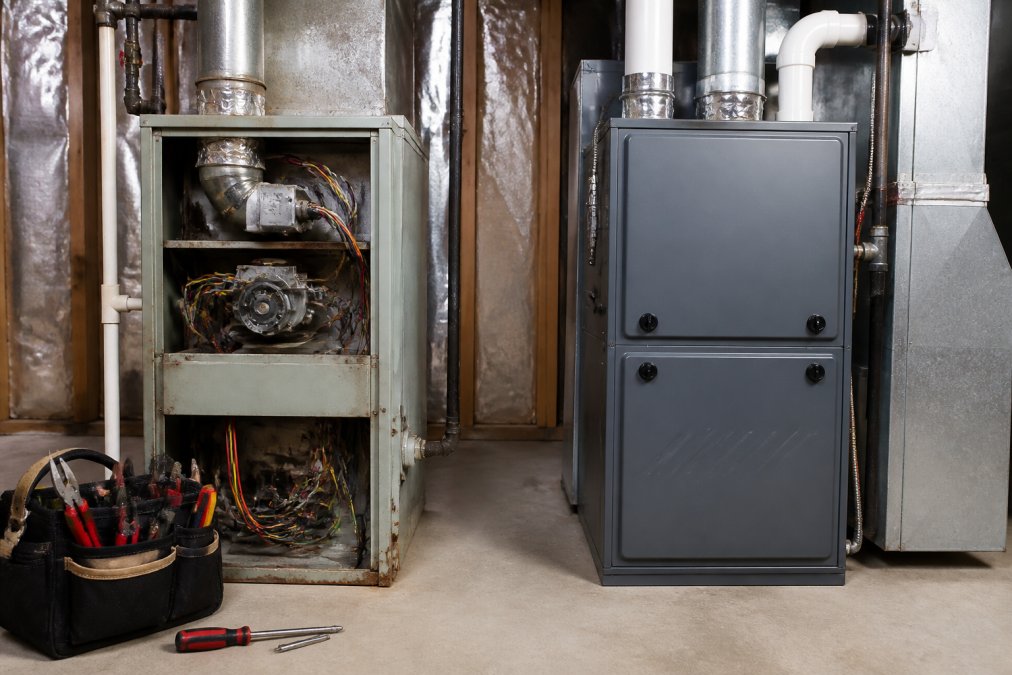
 comparison
Furnace Repair vs Replacement Cost Analysis for 2026
Table of Contents
- Furnace Repair vs Replacement Cost Analysis: The Core Framework
- The 50% Rule: When Repair Costs Cross the Line
- The HVAC $5,000 Rule Explained (And Where It Falls Short)
- Average Furnace Repair Cost: What You're Actually Paying For
- Signs Your Furnace Needs Replacing (Not Just Another Repair)
- Rebates, Tax Credits, and Financing: The Hidden Math of Replacement
- Environmental Impact and Long-Term Efficiency: The Case Competitors Skip
- Making the Call: A Practical Decision Framework for Homeowners
- Conclusion
- Frequently Asked Questions
Last Updated: September 26, 2026
Furnace Repair vs Replacement Cost Analysis: The Core Framework
A furnace repair vs replacement cost analysis is the process of comparing what a fix costs today against what a new system costs over its full service life, factoring in age, efficiency, and reliability. At Air CareSaver, we run this comparison on diagnosis calls, because the wrong call in either direction costs homeowners real money. The framework below covers the two classic rules of thumb, where each one breaks down, and the factors most guides leave out.
The 50% Rule: When Repair Costs Cross the Line
The 50% rule says that if a repair costs more than half the price of a new furnace, replacement usually wins. It is a useful starting filter because it forces a direct comparison instead of an emotional one.
The HVAC $5,000 Rule Explained (And Where It Falls Short)
The HVAC $5,000 rule is a quick formula: multiply the furnace's age by the repair cost, and if the result exceeds $5,000, replace the system. It gives homeowners a fast answer without waiting on a full quote comparison.
How to Run the Age x Repair Cost Calculation
- Find the equipment age. Check the rating plate on the furnace for the manufacture date.
- Get the full repair quote, including parts and installation labor.
- Multiply age by repair cost.
- Compare the result against $5,000.
- Cross-check the result against the 50% rule before deciding.
If the two rules disagree, treat that as a signal to get a technician assessment rather than a verdict.
Average Furnace Repair Cost: What You're Actually Paying For
Repair pricing depends on the failed component, the system capacity, and local labor rates, so no single figure applies to every home. What you can control is knowing what you are paying for before you approve the work.
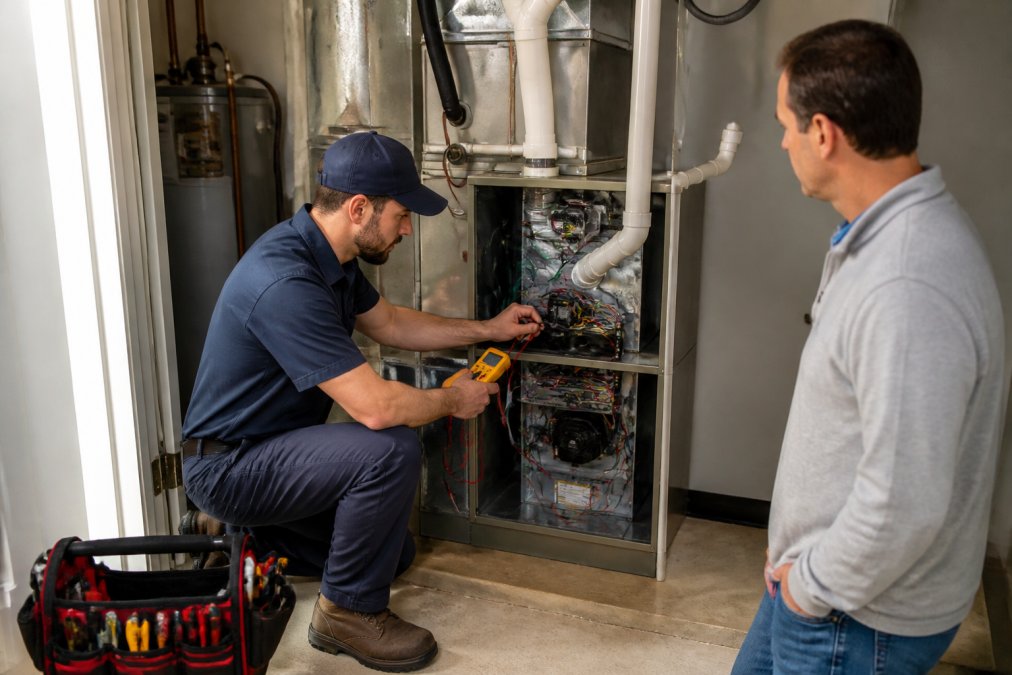
A repair quote typically bundles three things:
- Diagnostic time to identify the actual fault
- Parts, which vary widely by component and system capacity
- Installation labor, which scales with how deep the technician has to go
Typical Repair Costs by Component
| Component | Typical Installed Range | What It Tells You |
|---|---|---|
| Thermocouple or flame sensor | $150-$300 | Cheap fix; rarely a replacement trigger |
| Igniter | $200-$400 | Common failure; simple swap |
| Blower motor | $450-$900 | Restores core airflow; often worth it on a young system |
| Inducer motor | $500-$1,000 | Draft safety part; failure can trip the pressure switch |
| Control board | $600-$1,200 | Diagnosis-sensitive; misdiagnosis is common |
| Gas valve | $650-$1,200 | Safety-critical; confirm the diagnosis before approving |
| Heat exchanger | $1,500-$3,000+ | Often not worth repairing; see safety note below |
Why the Same Repair Costs Different Amounts
Three variables move the number more than anything else:
- System capacity. A 120,000 BTU furnace uses larger, more expensive parts than a 60,000 BTU unit, even for the same function.
- Equipment age and parts availability. On a 20-year-old unit, the part may be discontinued, which pushes the price up or forces a retrofit.
- Access and labor depth. A blower motor on a unit in a finished basement closet takes longer than the same motor in an open utility room.
The Most Common Avoidable Cost
The biggest waste is a repair that replaces parts without confirming the diagnosis. A short cycling furnace, for example, can be caused by an oversized system, a failing thermostat, or restricted airflow. Replacing the thermostat when the real problem is ductwork integrity wastes money twice: once on the part, and again when the symptom returns.
When the Repair Quote Should Trigger a Replacement Conversation
If the quoted repair lands above roughly half the installed price of a comparable new furnace, or if the failed part is the heat exchanger, stop and price a replacement before you approve the work. That comparison is the entire point of a repair vs replacement cost analysis, and it takes ten minutes.
Signs Your Furnace Needs Replacing (Not Just Another Repair)
Replacement is usually the right call when the system shows structural failure, not just a worn part. Watch for these signals:
- A cracked heat exchanger, which is a safety concern and not a repairable component
- Carbon monoxide detected by a working alarm
- Short cycling, where the furnace starts and stops every few minutes
- Yellow or flickering burner flames instead of steady blue
- Rust, corrosion, or soot streaks around the cabinet
- Equipment age past the typical furnace lifespan for its fuel type
- Rising utility bills with no change in usage habits
Rebates, Tax Credits, and Financing: The Hidden Math of Replacement
Replacement math changes once you subtract available incentives and spread the cost over time. Two homeowners can get identical quotes and face very different real numbers.
| Factor | Repair Now | Replace Now |
|---|---|---|
| Upfront cost | Lower | Higher |
| Monthly utility impact | Unchanged or rising | Often lower |
| Warranty coverage | Usually limited or none | Full on new equipment |
| Rebates and tax credits | Not eligible | May apply |
| Expected service life | Unknown | Known |
| Emergency repair risk | Continues | Reset |
Environmental Impact and Long-Term Efficiency: The Case Competitors Skip
Efficiency is where the repair-versus-replace debate actually gets decided, and most quick guides skip it entirely. Every furnace carries an energy efficiency rating called AFUE (Annual Fuel Utilization Efficiency), which measures how much of the fuel it converts into heat. A 90% AFUE furnace turns 90 cents of every fuel dollar into heat and vents the rest. An 80% AFUE furnace loses 20 cents up the flue every hour it runs.
The Efficiency Math, in Plain Numbers
AFUE differences compound over a heating season. A common pattern in colder climates: a 20-year-old furnace rated around 80% AFUE running alongside a modern 96% AFUE condensing unit. The gap is roughly 16 percentage points of fuel efficiency, which typically shows up as a double-digit percentage reduction in winter heating costs after replacement. Exact savings depend on your utility rates, climate, and how the system is sized and commissioned.
Three Environmental Factors That Belong in the Decision
- Fuel source. Natural gas, propane, and electric systems carry different emissions profiles and different operating costs. Electric resistance heat is typically the most expensive to run; modern heat pumps move heat rather than create it and can cut emissions further when paired with a cleaner grid.
- Combustion byproducts and indoor air. A failing heat exchanger affects indoor air quality, not just efficiency. Carbon monoxide, nitrogen oxides, and particulates are combustion outputs, and a compromised exchanger can leak them into the living space.
- Embodied carbon vs. operating carbon. Manufacturing a new furnace carries an environmental cost. Extending the life of a healthy unit through annual maintenance delays that cost. Replacing a failing, inefficient unit usually pays back the embodied carbon within a few heating seasons through reduced fuel use.
How Federal Incentives Change the Environmental Math
This is the part most guides leave out. Federal tax credit programs for high-efficiency home equipment have changed repeatedly in recent years, and the amount that applies to your installation depends on the equipment's rated efficiency and the rules in effect at purchase. High-efficiency gas furnaces and qualifying heat pump systems have both been eligible under recent programs. Check the current terms on the IRS energy-efficient home improvement credit page and confirm utility rebates directly with your provider before you sign.
Maintenance as an Environmental Strategy
Preventative maintenance and annual service keep a healthy unit running efficiently longer, which delays the environmental cost of manufacturing a replacement. A clean burn, correct gas pressure, and a clear flue all protect AFUE. Skipping service lets efficiency drift downward quietly, and the loss shows up on the utility bill before it shows up on the equipment.
Making the Call: A Practical Decision Framework for Homeowners
Use this sequence when you are staring at a repair quote and cannot decide.
- Confirm the diagnosis. Ask what failed, how it was tested, and whether the part failure explains the symptom.
- Apply the 50% rule. Repair above half the replacement price leans toward replacement.
- Run the age x repair cost calculation. Above $5,000 leans toward replacement.
- Count the recent repairs. Three or more in two years leans toward replacement.
- Check for structural failure. A cracked heat exchanger or carbon monoxide ends the debate.
- Subtract incentives and compare financing. This is where replacement often closes the gap.
- Get a second assessment if the two rules disagree. A technician assessment is far cheaper than a wrong decision.
Conclusion
The hardest part of this decision is not the math. It is trusting the quote in front of you and knowing whether the person writing it has your interest in mind. Air CareSaver is a family-owned, licensed team (#1054832) with more than 21 years of experience, a 4.9 Google rating, and 270+ reviews from neighbors who faced this exact call.
Frequently Asked Questions
What is the HVAC $5,000 rule for repairs?
The $5,000 rule multiplies your furnace's age by the repair cost. If the result exceeds $5,000, replacement is usually the better financial move. For example, a 12-year-old furnace with a $450 repair gives you $5,400, which points toward replacement. This rule is a starting point, not a final answer. It doesn't account for AFUE ratings, refrigerant or fuel type changes, or available rebates and tax credits that can shift the math significantly.
Should a 25-year-old furnace be replaced?
A 25-year-old furnace is well past the typical 15-20 year lifespan for most residential units. At that age, heat exchanger cracks, short cycling, and rising utility bills become common. Even a moderate repair often isn't worth it because parts availability drops and efficiency has fallen far below current standards. A technician assessment can confirm whether the heat exchanger is compromised, which is an immediate safety concern due to carbon monoxide risk.
How much does it cost to replace a furnace for a 2,000 sq ft house?
Furnace replacement pricing depends on system capacity (BTU), fuel source, AFUE rating, ductwork integrity, and installation labor. Air CareSaver provides free estimates so you get an accurate number for your specific home rather than a generic range. Factors like whether you need a new thermostat, updated venting, or duct sealing will affect the final cost.
Is it worth repairing a 20-year-old furnace?
It depends on the repair cost relative to replacement and the furnace's overall condition. If the repair is minor and the heat exchanger is intact, a repair can buy you a year or two. But at 20 years, you're on borrowed time. Frequent repairs, rising operational costs, and declining energy efficiency rating all signal that replacement delivers better return on investment. Get a technician assessment before deciding.
How do energy efficiency ratings impact the repair vs. replace decision?
AFUE ratings measure how much fuel becomes heat. An older furnace may run at 65-70% AFUE, while modern units reach 96% or higher. That gap shows up on utility bills every month. When you factor in available rebates and incentives for high-efficiency equipment, the long-term savings can offset a large portion of replacement cost. Ask your HVAC contractor to run a side-by-side comparison of your current system versus a new one.