 how-to
How to Troubleshoot a Furnace Not Turning On
Table of Contents
- Start Here: A Symptom-Led Furnace Troubleshooting Checklist
- Furnace Not Turning On but Has Power: Check the Thermostat First
- Power Supply Checks: Furnace Switch, Circuit Breaker, and Fuse
- Airflow Problems: Air Filter, Vents, and Blower Motor
- Ignition and Flame Problems: Igniter, Pilot Light, and Flame Sensor
- Furnace Reset Button Location and When to Use It
- Furnace Turns On but No Heat: Gas Valve, Control Board, and Error Codes
- Safety Boundaries and When to Call an HVAC Technician
- Frequently Asked Questions
Last Updated: October 6, 2026
Start Here: A Symptom-Led Furnace Troubleshooting Checklist
A furnace that will not start is usually a simple problem: a thermostat setting, a tripped breaker, or a clogged filter.
Furnace troubleshooting is the process of checking the thermostat, power supply, airflow, and ignition system in sequence to find why a heating system will not start. Most no-heat calls trace back to one of those four areas.
Here is the checklist we use:
- Set the thermostat to Heat and raise it 5 degrees above room temperature
- Replace weak thermostat batteries
- Check the furnace switch and the circuit breaker
- Inspect the air filter for blockage
- Open every supply and return vent
- Check the furnace door switch
- Watch the ignition and flame sensor
- Press the reset button once, if your furnace has one
Work through the list in order. Do not skip ahead.
The Furnace Startup Sequence: What Should Happen When You Call for Heat
Understanding the startup order makes the diagnosis faster. When your thermostat sends a call for heat, the sequence runs like this:
- The draft inducer fan starts and clears exhaust
- The pressure switch confirms airflow and closes
- The igniter glows or the pilot lights
If the sequence stalls at any step, the control board stops the cycle and often flashes a status light. That light is your best clue.
Furnace Not Turning On but Has Power: Check the Thermostat First
A thermostat set to Cool or Fan will never start the heat. This is the most common cause of a furnace not turning on but has power, and it takes ten seconds to rule out.
Check these settings:
- Mode: Set to Heat, not Cool or Off
- Set point: Raise it 5 degrees above the current room temperature
- Fan: Set to Auto, not On
A common mistake is testing the furnace while the thermostat is still in a programmed setback period. Press Hold or raise the set point manually.
Thermostat Settings, Batteries, and the Call for Heat
A thermostat sends a low-voltage signal, usually 24 VAC, to the control board. Weak batteries or a loose wire can break that signal, so the furnace never gets the call for heat.
Look for a blank screen, flickering display, or a thermostat that resets itself. Those point to a power problem at the thermostat, not the furnace.
Power Supply Checks: Furnace Switch, Circuit Breaker, and Fuse
The furnace switch looks like a light switch, often on a wall or ceiling near the unit. Someone may have flipped it off during service work. Check it first.
Next, check the circuit breaker:
- Open the panel and find the breaker labeled for the furnace
- Look for a breaker that sits between On and Off
- Flip it fully to Off, then back to On
- If it trips again right away, stop and call a technician
Some older furnaces use a fuse on the control board instead of a breaker. A blown fuse shows a dark or broken element, and it usually means something else failed first.
The Furnace Switch and Door Switch
The blower door switch cuts power when the access panel is open. If the panel is loose or the switch is stuck, the furnace will not start even with everything else correct.
Reseat the panel firmly. You should hear or feel the switch click.
Airflow Problems: Air Filter, Vents, and Blower Motor
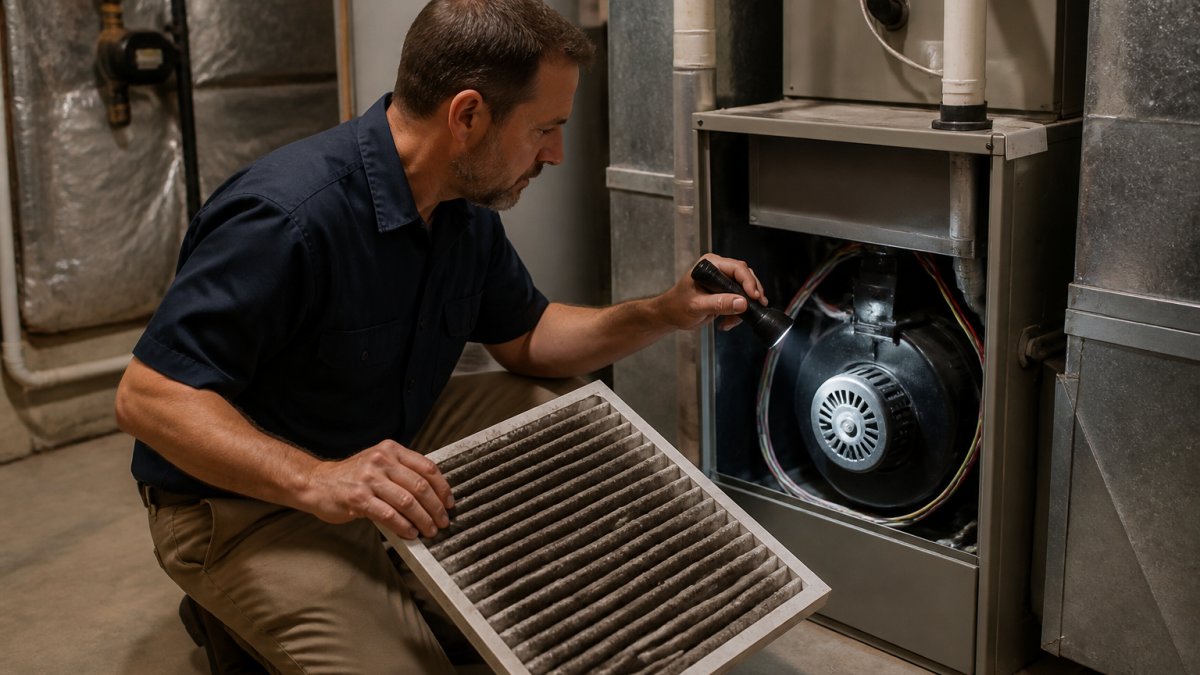
A clogged filter is the second most common cause of a no-start. Restricted airflow trips the high-limit switch, and the furnace shuts down for safety.
Check these airflow points:
- Hold the filter up to a light. If you cannot see through it, replace it
- Confirm the filter arrow points toward the blower
- Open every supply and return vent, including closed bedroom registers
A furnace that starts, runs briefly, then shuts off usually has an airflow issue, not an ignition issue.
Ignition and Flame Problems: Igniter, Pilot Light, and Flame Sensor
Ignition advice only works if it matches your fuel type. A gas furnace, an electric furnace, and an oil furnace fail in completely different ways, and applying gas-furnace steps to the wrong system wastes time or creates a hazard. Identify your system first, then use the matching section.
How to Tell Which System You Have
- Gas: You see a gas supply line and a shutoff valve at the cabinet, and a burner assembly with a pilot or igniter.
- Electric: No gas line. The cabinet contains heating elements (coils) and a sequencer or relay, not burners.
- Oil: You see an oil tank, a fuel line, and a burner with a nozzle, plus a reset button on the burner control.
Gas Furnace: Igniter, Pilot, and Flame Sensor
Modern gas furnaces use a hot surface igniter. Older models use a standing pilot light.
Watch the startup cycle through the sight glass, or with the door switch held closed:
- Hot surface igniter: Should glow orange within about 30 seconds of the inducer starting. No glow points to a failed igniter or a board that never sent voltage.
- Pilot light: Should burn with a steady blue flame. A yellow or lifting flame points to a dirty orifice or a draft problem.
- Flame sensor: Sits in the burner flame and returns a tiny current, measured in microamps, to the board. If the burners light and then cut out after a few seconds, the sensor is the usual culprit. A technician cleans it with steel wool or replaces it.
Electric Furnace: Elements and Sequencer
An electric furnace has no flame, so there is nothing to ignite. When it will not heat:
- The sequencer or relay staggers the elements on to avoid a power surge. A failed sequencer means the blower may run with no heat.
- The heating elements can open like a burnt-out light bulb. One failed element gives weak heat; all failed gives none.
- High-limit switches cut power to the elements if airflow drops. A clogged filter is the most common trigger.
Because electric furnaces run on 240 volts, the elements and sequencer are not homeowner-serviceable. Confirm the breaker and filter, then call a technician for anything inside the cabinet.
Oil Furnace: Burner, Nozzle, and Reset Button
An oil furnace ignites a fine spray of oil, so the failure points are different:
- The nozzle clogs over time and must be replaced, not cleaned, on a routine schedule.
- The electrodes that spark the oil mist wear and drift out of adjustment.
- The reset button on the burner control is a one-press item. If the burner locks out again after one press, stop, repeated presses can flood the combustion chamber with oil.
The Common Thread
Across all three systems, the pattern is the same: something proves that heat is safe to make, and if that proof fails, the furnace shuts down on purpose. In a gas unit it is the flame sensor; in an electric unit it is the high-limit and sequencer; in an oil unit it is the burner control. Find the proof step that is failing and you have found the fault.
Furnace Reset Button Location and When to Use It
The furnace reset button location varies by model. On most furnaces it sits behind the blower access panel, near the burner or on the control board. On older units it may be on the blower housing.
Press it once and wait. If the furnace locks out again, do not keep pressing it. Repeated lockouts mean a real fault, and forcing a restart can flood the burner area with gas.
Furnace Turns On but No Heat: Gas Valve, Control Board, and Error Codes
A furnace turns on but no heat when the blower runs yet the burners never light. This points to the gas valve, the control board, or a safety lockout.
Check these items:
- Confirm the gas supply valve at the furnace is open
- Check that other gas appliances in the home still work
- Look at the control board status light
Reading Diagnostic Codes by Furnace Model
Every brand uses its own flash pattern. A common pattern is a steady flash for normal operation and a set number of flashes for a fault, such as an open pressure switch or a locked-out ignition.
Write down the code before you call anyone. It saves diagnostic time.
| Symptom | Likely Cause | First Check |
|---|---|---|
| No response at all | Power or thermostat | Switch, breaker, batteries |
| Blower runs, no flame | Gas valve, igniter, sensor | Status light code |
| Lights then shuts off | Flame sensor or airflow | Filter, sensor |
| Trips breaker | Short or bad motor | Stop and call a tech |
Safety Boundaries and When to Call an HVAC Technician
Some jobs belong to a licensed technician. Gas valves, control boards, heat exchangers, and venting are not homeowner repairs.
Call a professional when you see:
- A gas smell or a hissing sound
- A cracked or rusted heat exchanger
- Repeated breaker trips
Testing a flame sensor signal, checking gas pressure, and confirming a heat exchanger needs meters and training. Guessing here risks carbon monoxide in the home.
If a basic fix fails, stop troubleshooting and call. At Air CareSaver, our licensed team (#1054832) provides same-day response and free estimates across Walnut and the San Gabriel Valley.
Frequently Asked Questions
Why is my furnace not turning on even though it has power?
Power at the outlet or panel does not guarantee the furnace is receiving a signal to start. Check the thermostat first: confirm it is set to Heat, the temperature is above the room reading, and the batteries are fresh. Then verify the furnace switch is on and the breaker has not tripped. A blocked air filter, a tripped door switch, or a failed igniter can also stop startup even when power is present. Work through a furnace troubleshooting checklist in order before assuming a major failure.
Is there a reset button on my furnace, and where is it located?
Many furnaces have a reset button, but the furnace reset button location varies by model. On older standing-pilot units, look near the gas valve for a red or black button. On modern high-efficiency furnaces, the reset is often a small button on the control board or a power cycle at the switch. Press it once and wait. If the furnace locks out again, do not keep pressing it. Repeated lockouts usually point to a failed igniter, flame sensor, or pressure switch that needs professional diagnosis.
Why does my furnace turn on but not heat even though the fan is running?
A furnace that turns on but no heat produces usually has a problem after the blower starts. Common causes include a dirty flame sensor that cannot confirm ignition, a gas valve that is not opening, a failed igniter, or a control board locking out the burners. Check that the gas supply valve is open and the filter is clean. If the burners never light, the issue is in the ignition or gas delivery path and typically requires an HVAC technician with a multimeter to test the 24 VAC signal and microamp readings.
Can a dirty air filter stop a furnace from turning on?
Yes. A severely clogged air filter restricts airflow, which can cause the furnace to overheat and trip its high-limit safety switch. When that switch trips, the burners shut off and the system may not restart until it cools. A blocked filter can also cause the pressure switch to read incorrectly on high-efficiency models, preventing ignition. Check the filter monthly during heating season and replace it every one to three months depending on household dust, pets, and system runtime.
A furnace that will not start is stressful, especially on a cold night with family or tenants waiting. Air CareSaver brings 21+ years of licensed experience, same-day response, and free estimates to every call, so you get a real diagnosis instead of guesswork. We repair, maintain, and install heating systems built for year-round comfort. Get started with Air CareSaver and get your heat back on today.