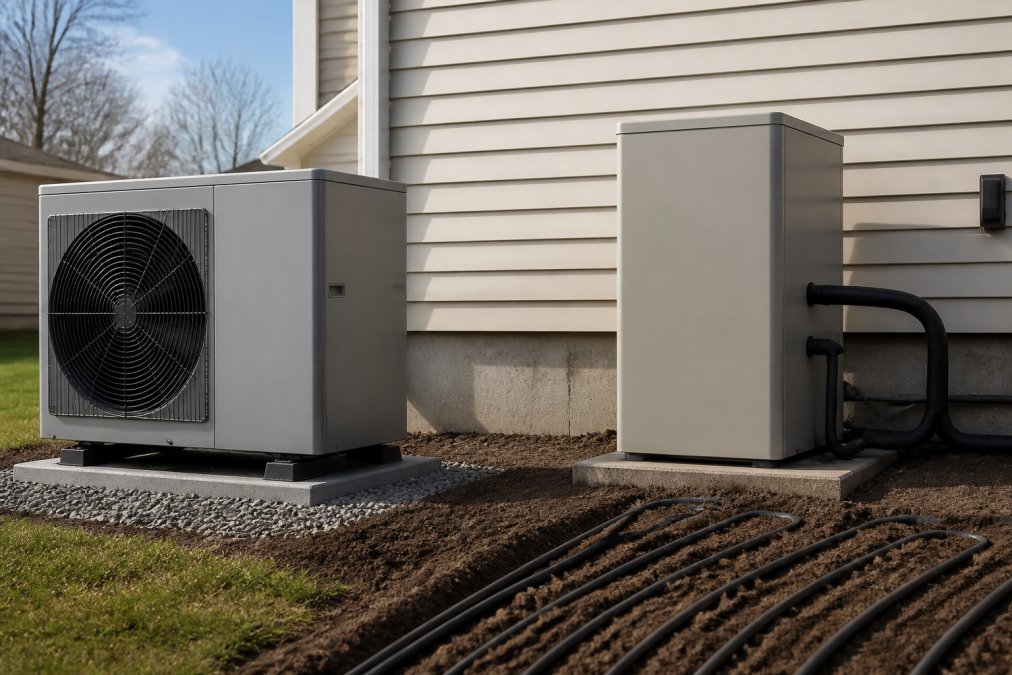
 comparison
Geothermal vs Heat Pump Cost Comparison: 2026 Guide
Table of Contents
- Geothermal vs Heat Pump Cost Comparison: The Bottom Line
- Air Source Heat Pump Installation Cost Breakdown
- Geothermal Tax Credit 2026: What You Can Claim
- Geothermal System Lifespan vs Air Source Heat Pump Longevity
- Total Cost of Ownership Over 20 Years
- Noise, Repairs, and Local Electricity Rates
- Which System Fits Your Home? A Decision Framework
- Frequently Asked Questions
Last Updated: September 25, 2026
Geothermal vs Heat Pump Cost Comparison: The Bottom Line
The geothermal heating vs heat pump cost comparison starts with a hard truth: geothermal systems cost far more upfront, but they often win on lifetime operating costs. Air source heat pumps cost much less to install and still deliver strong efficiency in mild climates. At Air CareSaver, we have over 21 years of licensed expertise in professional HVAC solutions, ensuring year-round comfort for residential and commercial properties in the Walnut and San Gabriel Valley communities.

Upfront Investment and Installation Costs
A ground source heat pump typically costs several times more to install than an air source heat pump, mainly because of the loop field and drilling work. A vertical vs horizontal drilling decision changes that number again. Horizontal loops need trenching across a large yard; vertical loops need deep boreholes but far less surface area.
Operating Costs and Energy Efficiency
Operating costs favor geothermal in most comparisons. A geothermal system's coefficient of performance stays high because ground temperatures barely move, while an air source unit's energy efficiency ratio drops as outdoor air swings hot or cold.
Air Source Heat Pump Installation Cost Breakdown
Air source heat pump installation is the lower-cost path, and that's why it dominates most retrofits. You skip drilling entirely. The equipment sits outside, connects to your existing HVAC system, and starts working the same week.
What Drives the Price: Equipment, Labor, and Ductwork
Three things move the number: equipment tier, installation labor, and ductwork compatibility. A variable speed compressor with an inverter drive costs more than a single-stage unit but runs more efficiently. Labor depends on whether your home needs new line sets, electrical upgrades, or duct sealing.
Hidden Costs Homeowners Miss
The costs nobody quotes you upfront are the ones that hurt. Watch for:
- Electrical panel upgrades for higher-draw equipment
- Duct sealing or replacement on older systems
- Permits and inspection fees
- Refrigerant line replacement
- Thermostat and control rewiring
Geothermal Tax Credit 2026: What You Can Claim
The geothermal tax credit 2026 is a federal incentive that can offset a meaningful share of your installed cost. Rules and percentages change, so confirm current terms before you buy.
How the Federal Incentive Works
Federal incentives for geothermal systems are administered through the tax code, and eligibility depends on system type, efficiency, and when it's placed in service (Residential Clean Energy Credit). Because the exact credit amount and rules shift, check the official IRS guidance on residential energy credits and the Department of Energy incentives database for current figures rather than relying on secondhand numbers.
Stacking State and Utility Rebates
Federal credits can often be combined with state and utility programs, which is where geothermal's math improves. Your installer should help you map every available geothermal tax incentive before you sign. Ask specifically which rebates apply to your ZIP code and equipment.
Geothermal System Lifespan vs Air Source Heat Pump Longevity
Geothermal system lifespan is the strongest argument for the higher price. Ground loop piping is built to last for decades, and because the indoor unit never faces weather, it avoids the wear that shortens outdoor equipment life.
| Factor | Geothermal | Air Source Heat Pump |
|---|---|---|
| Upfront cost | Highest | Lower |
| Operating cost | Lowest | Moderate |
| Lifespan | Longest | Shorter |
| Noise | Very quiet | Louder outdoors |
| Land needed | High | Minimal |
| Best for | Long-term owners | Fast retrofits |
Total Cost of Ownership Over 20 Years
Over 20 years, geothermal usually wins on total cost of ownership, but only if you stay long enough to clear the break-even point. The upfront premium is large; the annual savings chip away at it. Most guides stop there. This section does not, here is the actual framework to run the numbers yourself.
The Four Inputs That Decide Everything
- Installed cost, net of incentives. Take the gross quote, subtract the federal credit and any state or utility rebates, and use that net number. Incentives shrink the geothermal premium, sometimes dramatically.
- Annual heating and cooling load. This is your home's actual BTU demand, not square footage. A Manual J load calculation gives you this. Without it, every downstream number is a guess.
- Seasonal efficiency of each system. Geothermal holds a high coefficient of performance year-round because ground temperatures barely move. An air source unit's energy efficiency ratio drops as outdoor air swings hot or cold, so its real-world seasonal performance is lower than its rated peak.
- Your delivered electricity rate, including all charges. Not the headline rate, the all-in cents per kWh on your bill, including supply, delivery, and fixed fees spread across usage.
How the Break-Even Actually Shifts
The break-even year is not a fixed number. It moves with three things:
- Electricity price. Where power is expensive, geothermal's efficiency advantage is worth more per kWh saved, so payback shortens. Where rates are low, the payback stretches out, sometimes past the point where it makes sense.
- Climate severity. In a climate with long, cold winters and hot summers, the air source unit spends more hours at its least efficient, so geothermal's annual savings grow. In a mild climate, the gap narrows and the premium takes longer to recover.
- How long you stay. A 20-year projection only pays off if you own the home long enough to reach the crossover year. If you sell at year seven, you may hand the remaining payback to the buyer.
A Simple Way to Sanity-Check Any Quote
Ask each bidder for a 20-year cash-flow table with four columns: year, annual energy cost for that system, cumulative cost, and cumulative savings versus the alternative. If a bidder cannot produce one, that is a signal. A legitimate geothermal installer will have a modeling tool that does this; a box-swapper will not.
Where the TCO Math Usually Breaks Down
Three failure modes show up again and again:
- Using nameplate efficiency instead of seasonal efficiency. Air source units look better on the spec sheet than they perform across a full year.
- Ignoring maintenance and repair asymmetry. Geothermal has fewer moving parts exposed to weather, but when it does need work, specialized labor is scarcer and slower to schedule. Air source parts and techs are far more available, which keeps repair costs lower and downtime shorter.
- Forgetting the loop field is a one-time cost. The ground loop is built to last for decades and generally does not need replacement within a 20-year window, while an outdoor air source condenser may need replacement once or twice in the same period. That replacement cost belongs in the air source column.
Noise, Repairs, and Local Electricity Rates
Noise is a factor most guides skip. Geothermal units sit indoors and run quietly. Air source units put the compressor outside, where it's audible near bedrooms and patios.
Which System Fits Your Home? A Decision Framework
Use this framework to pick without guesswork:
- Staying 10+ years, have land or drilling access? Geothermal.
- Mild climate, fast retrofit, tighter budget? Air source heat pump.
- Planning to sell soon? Air source, unless the geothermal premium raises your resale value.
- High local electricity rates? Geothermal's efficiency is worth more.
- Tight lot, no room for loops? Air source.
Frequently Asked Questions
How much does it cost to put geothermal in a 2,000 sq ft house?
Geothermal installation for a 2,000 sq ft home typically runs higher than air source heat pump installation cost because of the ground loop field. Vertical drilling or horizontal trenching, plus the indoor heat pump unit and ductwork, make up most of the upfront investment. Pricing depends on soil conditions, loop type, and local labor rates. Request a free estimate from a licensed contractor for accurate numbers.
Does the federal geothermal tax credit still apply in 2026?
Yes. The federal geothermal tax credit 2026 remains available for qualifying ground source heat pump installations. It covers a percentage of the total project cost, including the loop field, equipment, and labor. There is no dollar cap on the credit for geothermal systems. Confirm eligibility with a tax professional and keep all installation receipts and manufacturer certifications for your filing.
What is the expected lifespan of a geothermal system compared to an air source heat pump?
Geothermal system lifespan typically reaches 20 to 25 years for the indoor unit and 50 years or more for the ground loop. Air source heat pumps generally last 10 to 15 years because the outdoor unit is exposed to weather, debris, and temperature swings. The indoor placement of geothermal equipment reduces wear, which is a major factor in its longer service life.
How do installation costs for ground source vs air source heat pumps compare?
Ground source systems cost significantly more upfront because of drilling or trenching for the loop field. Air source heat pump installation cost is lower since it requires only an outdoor condenser and indoor air handler. However, geothermal operating costs are usually lower, and the federal tax credit offsets a large portion of the upfront gap. The break-even point depends on your climate zone, electricity rates, and how long you plan to stay in the home.
Are there specific property requirements for installing geothermal heating?
Geothermal systems need either enough land for horizontal loops or space for vertical drilling. Lots under a quarter acre often require vertical wells, which cost more. Soil thermal conductivity, bedrock depth, and local permitting rules all affect feasibility. Retrofitting an older home may also require ductwork upgrades. A site assessment from a licensed HVAC contractor determines whether geothermal is practical for your property.
Choosing between geothermal and an air source heat pump comes down to your timeline, your land, and your power costs. Air CareSaver has installed and serviced both across the San Gabriel Valley for over 21 years, licensed (#1054832), with same-day response and free estimates. We handle accurate diagnostics, energy-efficient installations, and preventative maintenance so you avoid expensive breakdowns. Get started with Air CareSaver and get a system sized correctly for your home.